Showing posts with label Banking. Show all posts

Saturday, September 25, 2010

Punjab National Bank (PNB) - Stock that gained 64% in one year

Published on Fri, Sep 24, 2010 at 17:45   |  Updated at Fri, Sep 24, 2010 at 22:47  |  Source : CNBC-TV18

http://indihot.com/wp-content/uploads/2010/01/Punjab_National_Bank_PNB.jpg

The country's second largest public sector bank, Punjab National Bank (PNB) has seen a consistent rise in its stock price over the last one year. It has risen 64.5% in the last 52 weeks on the back of a strong performance in the last fiscal and its plans to increase its international footprint. It touched an intraday high today of Rs 1,300.25 and an intraday low of Rs 1,266.70. The share ended the day at Rs 1,285.15, up Rs 13.85, or 1.09%. There were pending buy orders of 445 shares, with no sellers available. The bank has a market capitalisation of Rs 40,521.10 crore.

Why the run-up?
With the economy projected to surpass 8.5% growth in GDP in the current fiscal, leading banks are expected to post higher profits on strong loan demand from the retail side as well as from corporates. A growing economy would also boost banks' asset quality while consumer defaults or bad loans are expected to fall. With well over 5,000 branches, PNB is well poised to take advantage of a growing India, after it reported a near 25% increase in net profit for the fiscal ended March 31, 2010, on the back of higher interest income.

The bank is also all set to build its footprint overseas. It has targetted to double its revenues from international operations by 2013. The bank plans to start a subsidiary in Canada to tap the country's significant punjabi population. It has foreign branches in Hong Kong, Kazakhstan, Shanghai, Singapore, Kabul and Dubai, as well as a subsidiary in the UK, and is expanding in more overseas markets. It also plans to upgrade its representative office in Norway into a full-fledged branch.
It is also looking to benefit from business opportunities due to a growth in bilateral trade by planning a foray into African markets like South Africa and Ghana and the South Asian nation, Indonesia.
The bank has charted out plans to grow inorganically in Kazakhstan, with its decision to acquire 64% stake in JSC Dana Bank for USD 24 million.

For the quarter ended June 2010, the bank reported a net profit of Rs 1,068 crore versus Rs 832 crore, a growth of 28.37% on a year-over-year basis (YoY). Its net interest income (NII) rose 40.67% to Rs 2,619 crore from Rs 1,861.8 crore YoY.
Around 15 lakh Punjab National Bank shares got traded in BSE FII segment today at Rs 1,525 per share. The block deal was executed at 17% premium to its (current) market price of Rs 1,295 per share.

What experts say:
Technical Analyst Sudarshan Sukhani says PSU banks are on a roll and have a long story ahead. "Punjab National Bank is a very good bank and the sector is excellent." Sukhani feels a two-year time horizon to get any long-term gains is the right timeframe for investment in the bank. He expects the bank to outperform the banking index.
VK Sharma of HDFC Securities said PNB continues to be a robust PSU bank and recommends investors to hold on to the stock from a long-term perspective.

Peer comparison:
Company
Last Price
Market Cap.
Net Interest
Net Profit (Rs cr)
Total Assets (Rs cr)
(Rs. cr.) Income (Rs cr)
SBI
3,141
199,478
70,994
9,166
1,053,414
PNB
1,285
40,527
21,467
3,905
296,633
Bank of Baroda
876
32,028
16,698
3,058
278,317
Bank of India
497
26,114
17,878
1,741
274,966
Canara Bank
574
23,514
18,752
3,021
264,741
Union Bank
385
19,460
13,303
2,075
195,162
Indian Bank
265
11,372
7,857
1,555
84,122
IDBI Bank
153
11,084
15,273
1,031
233,572
Oriental Bank
441
11,045
10,257
1,135
137,431
Allahabad Bank
228
10,194
8,369
1,206
97,648


Sunday, July 11, 2010

STOCK ANALYSIS: YES Bank


http://www.bypd.in/Yesbank/images/yesbank_big.jpg
As Yes Bank looks to expand beyond its mainly wholesale focus (on both lending and funding) to a stronger retail presence by scaling up to 750 branches from the present 150 in the next five years, its strong management and their sound execution history has added conviction on the strong performance going ahead.

The bank has targeted a 35% CAGR growth in advances and marginally higher deposit growth in this period, increasing low-cost CASA deposits (current account and savings account) by 2-3% every year. This should propel its revenues and earnings to grow at a clip of 30% over the next couple of years in tandem with peers, say analysts, adding that although targets are difficult to achieve, management expertise holds the key to execution. Having raised capital last year, the bank is well capitalized to fuel this growth with Tier I ratio at 12.9%.

The bank has seen its balance-sheet grow over 70% CAGR in the last four years, albeit over a small base with both deposits and loans growing at nearly 74% CAGR in this period. Net interest income and net profit after tax grew well over 50% y-o-y in FY10 to Rs 509 crore and Rs 304 crore, respectively. It maintained net interest margins at a reasonable 3.1% in FY10, up 20 bps y-o-y. Its portfolio quality is among the best in business with gross NPA ratio coming down 41 bps to 0.27% and Net NPA at 0.06% and specific loan loss provisioning coverage stands at 78% of gross NPAs. Its return on assets was 1.6% and return on equity was 23.75 for FY10and the bank also announced its first dividend of Rs 1.50 per share.

YES Bank has positioned its business model on a unique platform, with focus on developing wholesale business by catering to mid-tier and large corporates. It has specialized in key sectors including food and agri, engineering, TMT (technology, media and telecom), infrastructure, logistics and healthcare that together make up about 78% of its entire lending portfolio. The bank provides a one-stop shop for all financial services from extending credit to transaction banking to investment banking services with advisory services on accessing capital from debt markets, private equity and IPO’s. This has helped boost fee income 22% y-o-y to Rs 471 crore (48% of total income) in FY10.

This positioning means it is closely geared to the economic cycle with income spurting in an upswing such as in the current environment even as slippages and therefore provisioning requirements come down. However, the bank’s stock trades at a discount to other private bank peers like HDFC Bank and Axis bank, because of its current dependence on wholesale funding.

This dependence makes it vulnerable to margin pressures from higher cost of funds in a tightening cycle and the stock has been under pressure given impending policy rate hikes and expected monetary tightening in the face of runaway inflation. However, the stock has resurfaced after the policy rate hike turned out to be a moderate 25 bps alongwith a continued assurance from the RBI to maintain a calibrated approach to monetary tightening. Analysts believe that there is enough leeway for the bank to pass on the increase in funding costs. As the bank moves to grow its retail liabilities franchise, this risk will come down and with it, the valuation discount to peers giving some headroom for appreciation from these levels according to analysts.

The stock at Rs 275.75 trades at P/B valuation of about 2.6x adjusted book value per share estimates for FY11.

Strong Foundations

Why Buy
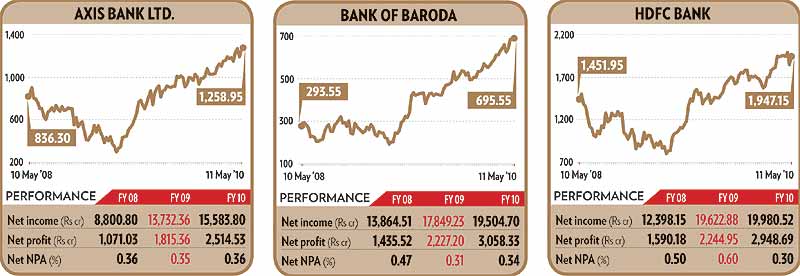
  • Axis Bank High business growth, low cost of funds, expanding NIM, improving asset quality
  • Bank of Baroda High growth in advances, best asset quality among PSU banks, high NPA provisioning, less volatile treasury income
  • HDFC Bank Consistently high growth, lower net NPA percentage compared to its peers, higher provisioning of NPA, large CASA base, high NIM
  • Punjab National Bank Low cost of funds, high yield on loans, maintains NIM in all conditions, higher NPA provisioning, less volatile bond portfolio
  • Yes Bank Lowest NPA percentage among listed banks, high growth, healthy NIM in spite of low CASA base
***
The Indian banking industry, unlike its peers in the West, came out relatively unhurt from the global financial crisis. The stocks, however, did correct a bit on the concerns of rising non-performing assets (NPAs) and loan restructuring. But, with the fear subsiding and the economy getting back to the higher growth path, there is renewed interest in the sector. The reasoning behind this is, if India has to grow at over 8-9 per cent, companies will need funds for expansion. In the absence of a vibrant bond market, they will have to tap banking sources for funding their needs. Therefore, investors are looking at this sector as a proxy to the India growth story. So, if you are also eyeing gains from the India growth story through the banking sector, we tell you how to look at stocks in the banking sector, and profile five banks we like at this stage.
Parameters
Core business. The core business of a bank is to lend, so it’s important to see how the advances have grown in the past, at least in the last few quarters. Looking at the growth in the interest income will also give you a fair idea. But, remember, this only a necessary but not a sufficient condition. Says Rajiv Mehta, research analyst at IndiaInfoline: “If a bank is growing at, say, 5-10 per cent faster than the industry, we try to analyse how it manages its margins and asset quality.” There is a possibility that to gain market share the bank might be ignoring the quality of lending.

Crests And Troughs
Although banking stocks fell along with the overall market as global crisis intensified, it has rebounded sharply and outpaced the overall market on prospects of economic recovery.

Asset quality. In banking, asset quality is of prime importance and looking only at profitability is not enough. “It [profits] is not the right criterion to look for a good bank; you should rather look at the balance sheet,” says Arun Khurana, manager, banking sector fund at UTI MF. He uses the example of Vijaya Bank. For FY10, it reported a profit of Rs 502 crore, or Rs 240 crore higher than the previous year’s profit of Rs 262 crore. Thus, its profit almost grew by 92 per cent. But, at the same time, its net NPA also grew by Rs 289 crore. Khurana suggests that one should reduce net profit by increase in net NPA to get the real profit figure because the bank is not sure whether it will recover NPAs. Also, from September 2010, banks will have to provide for 70 per cent of gross NPA, which will dent profits significantly for banks not making sufficient provisioning at this stage.
Net interest margin (NIM). It is a measure of the bank’s profitability, and is calculated as net interest income (interest income minus interest expenses) divided by interest yielding assets. This checks the bank’s ability to price loans at higher rates, which is also function of bank’s ability to mobilise low cost deposits—current account and saving account (CASA). The higher the CASA ratio, the better it is. Also, as we are moving into higher rate scenario, CASA will become even more important. Says Vaibhav Agrawal, vice-president, research, at Angel Broking: “As interest rates go up, the banks with the highest CASA account will perform the best.”
Other income. There are two big components of other income: fee income and treasury income. Although growth in fee income can be predicted somewhat, treasury income is relatively volatile. It depends on the wider interest rates situation in the economy, and is also affected by various factors like the monetary policy and government borrowing. As banks in India are required to keep 25 per cent of their demand and time liability in government securities, the overall effects of bond price movement can only be managed a little.
The road ahead
Unanimous projections. The fiscal year 2010 wasn’t too good for the banking industry in terms of loan disbursal. It remained subdued for most of this period, even as growth in credit fell to single digits at the end of October 2009. But later, as economic activity picked up, credit growth accelerated to around 17 per cent at the end of the financial year. Analysts expect it to remain robust. The offtake is once again expected to come from the infrastructure space, which, after a lull, has started witnessing higher activity. “Banks have raised capital in the previous year. Further, the government’s decision to infuse capital into some banks would increase their limit for infrastructure lending,” says Rajrishi Singhal, head of research and policy, Dhanlaxmi Bank.
Treasury Tricks. When the RBI followed the policy of lower interest rates to bring growth on track, the yield on government bonds came down. As a result, banks made huge profits on bond portfolios. However, that trend has reversed now. The yields have risen significantly, with impacts already visible on banks’ result for the March 2009 quarter. Most banks have suffered losses on bond portfolios. Analysts believe that in the coming quarters, too, the bond yield will remain high and it would be difficult for banks to show treasury gains. But yields are not expected to harden too much from here on. Economists expect yields on 10-year government paper to move at most to 8.5 per cent from the current 7.8 per cent. So, major negative surprises can be ruled out. Also if the government raises the FII limit in G-secs, as reported by the financial media, greater demand will raise their prices, thereby restricting the rise in yield.
Maintaining Margins. The net interest margin rose in FY10. One of the causes behind this rise was the high proportion of low-cost CASA deposits in the overall deposit base. As rates on term deposits were low, it became less attractive, and the share of CASA increased.
However, as term deposit rates have started to rise again, banks will face difficulty in maintaining the CASA level, even as pressure might be compounded by the lag that exists in adjustment of lending and deposits rates. Suresh Ganapathy and Mudit Painuly of Macquarie Equities Research, say in a recent report: “The previous interest rate cycle was testimony to the hypothesis that lending rates, particularly in the case of Indian banks, react with a two or three quarter lag, compared to deposit rates. We expect this lag, coupled with an increase in savings rates, to exert pressure on margins in FY11.”
Banking Picks
Axis Bank. It posted another quarter and year of impressive numbers. March 2010 was the 22nd quarter in a row when the bank posted net profit growth in excess of 30 per cent. During the year, net profit went up by 39 per cent, while the net interest income was up 36 per cent, showing growth of 47 per cent in 5-year CAGR. Similarly, the fee income for the bank grew by 51 per cent CAGR over the five years ending FY 10. The bank continues to maintain good asset quality with net NPA at 0.36 per cent compared to 0.75 at the end of FY06. During the fourth quarter, advances for the bank grew by a healthy 28 per cent over the previous year, against the industry’s growth of just about 18 per cent. The cost of funds also declined to 4.54 per cent against 6.64 per cent in Q4FY11, which led to improved net interest margins of 4.09 per cent.
On 12-month trailing earnings, the stock is trading at 18.78 times. Given that is consistently growing at over 30 per cent, the stock does not look too expensive.
Bank of Baroda. Bank of Baroda, or BoB, is a preferred pick in the public sector. A higher concentration in industrialised states such as Maharashtra and Gujarat gives greater push to its business. In FY10, deposits grew 25.3 per cent over the previous year. The yearly growth in advances was lower than the previous year, but, at 22.2 per cent, it was still higher than the average for the banking industry. The asset quality remained high, with net NPA at 0.34 per cent of the net advances, which is the best among PSU banks. The bank maintains a strong balance sheet by provisioning 74.90 per cent of NPAs. Another positive aspect of this bank is the low volatility of its treasury income, unlike other PSU banks, as it categorises most securities as held-to-maturity, which are not marked-to-market as bond yield fluctuates.
Factoring better earning visibility and superior asset quality, at Rs 695, BoB’s share is trading 8.24 times its FY10 EPS.
HDFC Bank. HDFC Bank’s stock enjoys the highest premium among the large-cap banks. The reasons are obvious. It has consistently maintained a high growth rate without compromising on asset quality. Advances have grown by 39 per cent annually in the past three years. In spite of high growth, its asset quality is still one of the best in the industry, at net NPA around 0.3 per cent of net advances. The provisioning coverage is also high. Even though its provisioning policy is conservative (making larger provisions), the growth in profit is high and in the previous 42 quarters, it has maintained around 30 per cent annual growth in net profits. Because of high CASA deposit (around 50 per cent of the total deposits), the net interest margin of the bank is high and has helped it report high growth in net profit.
At a price-to-book value of four and PE of 29, the valuation may not rise, but growth in earnings would support the price rise.
Punjab National Bank. It is the most preferred choice among public sector banks. The differentiating factor is its ability to maintain high net interest margins. High CASA deposits in the overall deposit base helps it lower the cost of funds, while high lending to MSME (micro, small and medium enterprises) enable it price loans at higher rates. As a result, the NIM remains high.
Though there is a relatively higher risk related to restructured loan portfolios, the already high provisioning will ensure that the impact is minimal when the restructured loans turn bad. Another positive factor is that the value of the bank’s bond portfolio is less volatile as around 80 per cent of it is categorised as held-to-maturity, which is not marked-to-market.
At a price of Rs 1,017.05, PNB’s stock is trading 12 times FY10 EPS—a level attractive enough to ride on the bank’s growth.
Yes Bank. With the best asset quality and a strong growth rate, it is among analysts’ favourite stocks in the segment. At the end of the March 2010 quarter, the bank had a net NPA of just 0.06 per cent, while operating profits were up by 67.3 per cent compare to the same quarter last year. For the whole of FY10, the operating profit was up 63.6 per cent, while net interest income witnessed an upswing of 54.7 per cent. Interestingly, despite significant improvement in the CASA, Yes Bank's low cost deposits were at 10.5 per cent, much lower than large banks. Despite this, the bank had a net interest margin of 3.2 per cent, which is significantly better than most public sector banks.
Yes Bank has built its expertise in corporate banking and retail constitutes a very small part of its business. However, going forward, in the second phase of expansion (2010-15), it plans to accelerate its presence in commercial banking and aims to grow its balance sheet from the Rs 36,382 crore at present to Rs 1,50,000 crore. In terms of valuation, on a trailing 12-month basis, the stock is trading at 17 times.
Investors entering this stock are advised to take a long term earnings expansion play and not PE expansion.

Friday, June 11, 2010

India's top 10 banks

For the past few months banks all over the Western world and a few in Asia too have been in the news for all the wrong reasons.

Zombie banks, bank bailout, bank merger -- are some of the phrases that are doing the rounds to describe these banks, many of whom have gone belly up.

Worldwide, governments have used taxpayers' money to bail out banks. The story is no different in India.

However, thanks to minimal exposure to the American housing market and the regulated regime under which they have to operate, Indian banks have been largely insulated from the financial crisis that is wreaking havoc.

In a recent survey conducted by rediff.com, we had asked readers to name the best banks operating in India: the response was overwhelming.

We were inundated with readers' replies as they ranked India's best banks based on the banks' services, customer-experience, perception, etc.

State Bank of India


Starting its journey as the Bank of Calcutta on June 2, 1806, the State Bank of India today offers the largest banking network in the country.

SBI boasts of over 10,000 branches and 8500 ATMs, and has 82 offices in 32 countries across the globe.

SBI is also the only Indian bank to feature in the Fortune 500 list.

The bank's net profit for Q3FY09 stood at Rs 2,478 crore (Rs 24.78 billion), up by 37.03 per cent from Rs 1,809 crore (Rs 18.09 billion) in Q3FY08.

HDFC Bank


The Housing Development Finance Corporation Limited was amongst the first to receive an 'in principle' approval from the Reserve Bank of India to set up a bank in the private sector, as part of the RBI's liberalisation of the Indian Banking Industry in 1994.

The bank was incorporated in August 1994 as HDFC Bank Limited, with its registered office in Mumbai.

HDFC Bank commenced operations as a Scheduled Commercial Bank in January 1995.

It reported 44.8 per cent rise in Q3 net profit for the quarter ended December 31, 2008 at Rs 621.74 crore (Rs 6.22 billion).

ICICI Bank


ICICI Bank was originally promoted in 1994 by ICICI Limited, an Indian financial institution, and was its wholly-owned subsidiary.

In October 2001, boards of both the entities approved the merger of ICICI and two of its wholly-owned retail finance subsidiaries, ICICI Personal Financial Services Limited and ICICI Capital Services Limited, with ICICI Bank.

The merger got the final nod in April 2002.

ICICI Bank, the second largest bank in India had total assets of Rs 37,4,410 crore ($77 billion) on December 31, 2008 and its profit after tax was Rs 3,014 crore (Rs 30.14 billion) for the nine months ended December 31, 2008.

It has a network of 1,419 branches and about 4,644 ATMs and is present in countries like United Kingdom, Russia, Canada, United States, Singapore, Bahrain, Hong Kong, Sri Lanka, Qatar, Dubai, United Arab Emirates, China, South Africa, Bangladesh, Thailand, Malaysia, Indonesia, Belgium and Germany.

Punjab National Bank


Established in 1895 at Lahore (then undivided India), Punjab National Bank was nationalised in July 1969.

Today, with assets of more than Rs 199,000 crore (Rs 1,990 billion), PNB is the third largest bank in India after SBI and ICICI Bank and has 4589 branches.

PNB's standalone Q3 net profit was up 85.61 per cent at Rs 1,005.8 crore (Rs 10.06 billion).

Bank of Baroda


Known as 'India's International Bank', it has been a long and eventful journey for BoB.

Present across 25 countries, Bank of Baroda started its journey in 1908 from a small building in Baroda.

In 1995, the bank underwent a rebranding exercise and started sporting a new logo -- dual letter 'B' holding the rays of the rising sun.

The founder, Maharaja Sayajirao Gaekwad, started the bank with a paid up capital of Rs 10 lakh (Rs 1 million).

Today BoB boasts of 2956 branches (including those outside India), and has a staff strength of 38,063.

It first tapped the equity market in December 1996 and the second IPO -- of 71 million equity shares -- was in January 2006. Today out of the total equity capital of Rs 365.53 crore (Rs 3.66 billion), public shareholding is at 46.19 per cent.

Its standalone net profit for the third quarter ended December 31 rose by 41.37 per cent to Rs 708.37 crore (Rs 7.08 billion).

Canara Bank


Founded as Canara Bank Hindu Permanent Fund in 1906, by Ammembal Subba Rao Pai, a philanthropist, and nationalised in 1969, the bank was the first to be conferred with ISO 9002 certification for one of its branches in Bangalore.

Canara Bank or CanBank has 2710 branches and over 2000 ATMs.

It reported a 52.89 per cent growth in net profit to Rs 701.50 crore (Rs 7.01 billion) in the third quarter ended December 31, 2008.

Bank of India


Bank of India was founded on September 7, 1906 by a group of eminent businessmen from Mumbai.

The bank was under private ownership and control till July 1969 when it was nationalised.

Beginning with one office in Mumbai, with a paid-up capital of Rs 50 lakh (Rs 5 million) and 50 employees, BoI today boasts of 2884 branches in India.

It was the first Indian bank to open an overseas branch (at London, in 1946).

BoI has 27 oversaes branches including those at London, New York, Paris, Tokyo, Hong-Kong and Singapore.

Axis Bank


In July 2007, UTI Bank re-branded itself as Axis Bank. Today, the bank is capitalised to the extent of Rs 358.97 crores (Rs 3.59 billion) with the public holding (other than promoters) at 57.59 per cent.

The bank has a very wide network of more than 729 branch offices and extension counters and has a network of over 3171 ATMs.

The bank was set up with a capital of Rs 115 crore (Rs 1.15 billion), with earstwhile financial major Unit Trust of India contributing Rs 100 crore (Rs 1 billion), Life insurance Corporation - Rs 7.5 crore (Rs 75 million) and General Insurance corporation and its four subsidiaries contributing Rs 1.5 crore (Rs 15 million) each.

Axis Bank reported a 63.24 per cent surge in net profit at Rs 500.86 crore (Rs 5.01 billion) for the third quarter ended 31 December, 2008.

Corporation Bank


Started about 102 years ago in 1906, with an initial capital of just Rs 5000, Corporation Bank has already surpassed the land mark of Rs 1 lakh crore (Rs 1 trillion) in business, with over 2000 service outlets across the nation.

In 1997, it became the Second Public Sector Bank in the country to enter the capital market, the IPO of which was over- subscribed by 13 times.

Mangalore-headquartered Corporation Bank reported a 34.3 per cent jump in its net profit to Rs 256.4 crore (Rs 2.56 billion) for the third quarter ended December 31, 2008.

HSBC Bank


The history of the HSBC Group in India can be traced back to October 1853 when the Mercantile Bank of India, London and China was founded in Bombay (now Mumbai).

Starting with an authorised capital of Rs 50 lakh (Rs 5 million), the Mercantile Bank opened offices in London, Madras(Chennai), Colombo and Kandy, followed by Calcutta(Kolkata), Singapore, Hong Kong, Canton(Guangchow) and Shanghai by 1855.

In 1959 the Hongkong and Shanghai Banking Corporation acquired the Mercantile Bank and this led to the foundation of today's HSBC Group.

HSBC gave India its first ATM way back in 1987.

20 Indian banks in top 500 global banking list

They may not be bankers to the world yet, but Indian banks have clearly set their eyes on that. In a year that saw the worst recession for the global banking industry with several big daddies collapsing, resilient Indian banks have improved their brand value rapidly. There are 20 Indian banks in the Brand Finance® Global Banking 500, an annual international ranking by UK-based Brand Finance Plc, this year.

The State Bank of India (SBI) became the first Indian bank to break into the world’s Top 50 list, according to the Brand Finance study that saw HSBC retain its top slot for the third year in a row.

The study, released on Sunday and made exclusively available to ET in India, used discounted cash flow methodology to arrive at a net present value (NPV) of the trademark and associated intellectual property: the brand value. SBI’s brand value more than tripled to $4,551 million, up from $1,448 million in 2009 helping it grab the 36th spot in the list. ICICI Bank, the country’s largest private bank, joined it in the Top 100 list with a 130% jump in its brand value at $2,164 million.

Other big gainers in brand value include IDBI Bank (190%), Bank of Baroda (162%) and Union Bank of India (148%). The cumulative brand value of 20 Indian banks stood at $13,053 million. The 15 Indian banks that figured in last year’s list saw a whopping 130% rise in their combined brand value.

The number of Indian banks in the global list had more than tripled last year to 19 from six in 2007. Differentiation through strong brand and customer base value is becoming a key economic lever for Indian banks. This is as true in financial services as in consumer products.

“Indian banks need to recognise their inherent brand value potential and SBI’s remarkable performance by breaking into the top 50 financial services brands offers a lesson for others,” said Unni Krishnan, MD of Brand Finance India. SBI seems to be fast transforming into a brand-led business, with a broader, more holistic and sophisticated approach to managing the brand and stakeholder relationships.

“Brands act as a common glue that binds all the business functions, especially in financial services firms, resulting in greater coherence of strategy, service excellence and sustained business performance,” said Unni Krishnan, MD of Brand Finance India.

Asian aura shows Over all, HSBC remained the biggest bank brand for the third year in a row with its brand value rising 12% to $28,472 million. This must have been a relief to the bank that saw its brand value erode by 28% in 2009 league table.

The study notes that global banking sector has begun to show tangible signs of recovery, with the world’s 500 most valuable banking groups growing by 62% in terms of market capitalisation and their brand values cumulatively increasing by 49%.

“This year’s BrandFinance® Global Banking 500 shows how significant the recovery of global banking brands has been,” said David Haigh, CEO of Brand Finance plc. The total brand value of the Top 500 banks stands at $716 billion, up 49% over 2009 and 4% higher than in 2008, prior to the crisis.

“There has been a significant shift in the balance of power globally away from the US and towards banks in emerging markets,” said Mr Haigh.

The Asia region contributed 17% to the total global brand value, logging 31% growth in 2010. However, the number of Asian banks in the global 500 has dropped to 102 in 2010 from 120 the previous year.

Almost all banks in the Asian Top 10 have increased in brand value. However, this rise is not as strong as witnessed in more developed regions like Europe and North America, as they recover from the crisis.

Although the number of banks reported in the Top 500 from Asia has decreased, many banks in the region tend to be well capitalised and in countries such as India, banks have become far more competitive.

As such, the normalisation of markets has not had such a relatively profound increase in brand value in the Asian region. As was the case last year, the Asian Top 10 is dominated by Chinese banks with the gap between the major Chinese banks and the rest widening.

The biggest movement in the league table was made by SBI, which has seen its brand value more than triple to sixth biggest bank brand in Asia.

Another notable entrant is Standard Chartered, which has stepped up its Asian presence in recent years, saw a robust 59% growth in its brand value.

While the brand value increased, market capitalisation of the top 500 came down by 20% since 2008.
The US dominance of global banking has declined further with a decrease in the number in the global 500 down to 85 from 95 in 2009. The number of European banks in the list increased from 170 to 197, while that from the UK decreased from 24 to 22.

This suggests that the recovery on the European continent in particular France, Spain, and Switzerland has left British banks standing. The league table also notes that bank brands in emerging markets are slowly closing the gap. The top 20 bank brands in 2010, originate from nine countries, one more than 2009. It is for the first time that a Russian bank has made the top 20 (Sberbank) which has seen significant growth.

The Middle East has seen a 117% growth in brand value, based on high demand for Islamic banking products and services. On the other hand, Central America has seen a 40% decline in brand value. European bank brands have recovered significantly compared to the North American and Asian markets (78%, 30% and 26% growth, respectively).
Banks in the Pacific, including Australia and New Zealand have seen a recovery with growth of 58%.

Top 10 Banks in India

This site lists the top 10 Banking companies in both public and private sectors in India, servicing needs such as Retail Banking Services, Personal loans, Vehicle Loans, Life Insurance, Health insurance Mutual Funds, stock investment etc

You also get additional services such as mutual fund investment advice, Share market advice, housing loan finance advice, NRI schemes and pension schemes

Whatever you needs may be, just login to the particular bank's official site listed below and find your answers


10. Oriental Bank of Commerce

Parameters to identify healthy Banking stocks

It's very difficult to understand the Banking business thoroughly. However, to find some safer banking stocks one should look at the parameters given below.

1) Core business:
The core business of a bank is to lend, so it's important to see how the advances have grown in the past, at least in the last few quarters. Looking at the growth in the interest income will also give you a fair idea. But, remember, this is only a necessary but not a sufficient condition. As there is a possibility that to gain market share the bank might be ignoring the quality of lending.


2) Crests And Troughs:

Although banking stocks fell along with the overall market as global crisis intensified, it has rebounded sharply and outpaced the overall market on prospects of economic recovery.

3) Asset quality:
In banking, asset quality is of prime importance and looking only at profitability is not enough. Profits is not the right criterion to look for a good bank; one should rather look at the balance sheet. For e.g. Vijaya Bank. For FY10, it reported a profit of Rs 502 Cr, or Rs 240 Cr higher than the previous year's profit of Rs 262 Cr. Thus, its profit almost grew by 92 %. But, at the same time, its net NPA also grew by Rs 289 Cr.

The Bank should reduce net profit by increase in net NPA to get the real profit figure because the bank is not sure whether it will recover NPAs. Also, from September 2010, banks will have to provide for 70 % of gross NPA, which will dent profits significantly for banks not making sufficient provisioning at this stage.

4) Net interest margin (NIM):
It is a measure of the bank's profitability, and is calculated as net interest income (interest income minus interest expenses) divided by interest yielding assets. This checks the bank's ability to price loans at higher rates, which is also function of bank's ability to mobilise low cost deposits -- current account and saving account (CASA). The higher the CASA ratio, the better it is. Also, as we are moving into higher rate scenario, CASA will become even more important. Since as interest rates go up, the banks with the highest CASA account will perform the best.


5) Other income:
There are two big components of other income: fee income and treasury income. Although growth in fee income can be predicted somewhat, treasury income is relatively volatile. It depends on the wider interest rates situation in the economy, and is also affected by various factors like the monetary policy and government borrowing. As banks in India are required to keep 25 % of their demand and time liability in government securities, the overall effects of bond price movement can only be managed a little.


6) The road ahead:

Unanimous projections: The fiscal year 2010 wasn't too good for the banking industry in terms of loan disbursal. It remained subdued for most of this period, even as growth in credit fell to single digits at the end of October 2009. But later, as economic activity picked up, credit growth accelerated to around 17 % at the end of the financial year. Analysts expect it to remain robust. The offtake is once again expected to come from the infrastructure space, which, after a lull, has started witnessing higher activity.
Banks have raised capital in the previous year. Further, the government's decision to infuse capital into some banks would increase their limit for infrastructure lending.

7) Treasury Tricks:
When the RBI followed the policy of lower interest rates to bring growth on track, the yield on government bonds came down. As a result, banks made huge profits on bond portfolios.

However, that trend has reversed now. The yields have risen significantly, with impacts already visible on banks' result for the March 2009 quarter. Most banks have suffered losses on bond portfolios.
Analysts believe that in the coming quarters, too, the bond yield will remain high and it would be difficult for banks to show treasury gains. But yields are not expected to harden too much from here on.
Economists expect yields on 10-year government paper to move at most to 8.5 % from the current 7.8 %. So, major negative surprises can be ruled out. Also if the government raises the FII limit in G-secs, as reported by the financial media, greater demand will raise their prices, thereby restricting the rise in yield.

8) Maintaining Margins:
The net interest margin rose in FY10. One of the causes behind this rise was the high proportion of low-cost CASA deposits in the overall deposit base. As rates on term deposits were low, it became less attractive, and the share of CASA increased.

However, as term deposit rates have started to rise again, banks will face difficulty in maintaining the CASA level, even as pressure might be compounded by the lag that exists in adjustment of lending and deposits rates. The previous interest rate cycle was testimony to the hypothesis that lending rates, particularly in the case of Indian banks, react with a two or three quarter lag, compared to deposit rates. We expect this lag, coupled with an increase in savings rates, to exert pressure on margins in FY11.

Thursday, June 10, 2010

Banking - Strong Foundations

Why Buy
  • Axis Bank High business growth, low cost of funds, expanding NIM, improving asset quality
  • Bank of Baroda High growth in advances, best asset quality among PSU banks, high NPA provisioning, less volatile treasury income
  • HDFC Bank Consistently high growth, lower net NPA percentage compared to its peers, higher provisioning of NPA, large CASA base, high NIM
  • Punjab National Bank Low cost of funds, high yield on loans, maintains NIM in all conditions, higher NPA provisioning, less volatile bond portfolio
  • Yes Bank Lowest NPA percentage among listed banks, high growth, healthy NIM in spite of low CASA base

***

The Indian banking industry, unlike its peers in the West, came out relatively unhurt from the global financial crisis. The stocks, however, did correct a bit on the concerns of rising non-performing assets (NPAs) and loan restructuring. But, with the fear subsiding and the economy getting back to the higher growth path, there is renewed interest in the sector. The reasoning behind this is, if India has to grow at over 8-9 per cent, companies will need funds for expansion. In the absence of a vibrant bond market, they will have to tap banking sources for funding their needs. Therefore, investors are looking at this sector as a proxy to the India growth story. So, if you are also eyeing gains from the India growth story through the banking sector, we tell you how to look at stocks in the banking sector, and profile five banks we like at this stage.

Parameters

Core business. The core business of a bank is to lend, so it’s important to see how the advances have grown in the past, at least in the last few quarters. Looking at the growth in the interest income will also give you a fair idea. But, remember, this only a necessary but not a sufficient condition. Says Rajiv Mehta, research analyst at IndiaInfoline: “If a bank is growing at, say, 5-10 per cent faster than the industry, we try to analyse how it manages its margins and asset quality.” There is a possibility that to gain market share the bank might be ignoring the quality of lending.


Crests And Troughs

Although banking stocks fell along with the overall market as global crisis intensified, it has rebounded sharply and outpaced the overall market on prospects of economic recovery.


Asset quality. In banking, asset quality is of prime importance and looking only at profitability is not enough. “It [profits] is not the right criterion to look for a good bank; you should rather look at the balance sheet,” says Arun Khurana, manager, banking sector fund at UTI MF. He uses the example of Vijaya Bank. For FY10, it reported a profit of Rs 502 crore, or Rs 240 crore higher than the previous year’s profit of Rs 262 crore. Thus, its profit almost grew by 92 per cent. But, at the same time, its net NPA also grew by Rs 289 crore. Khurana suggests that one should reduce net profit by increase in net NPA to get the real profit figure because the bank is not sure whether it will recover NPAs. Also, from September 2010, banks will have to provide for 70 per cent of gross NPA, which will dent profits significantly for banks not making sufficient provisioning at this stage.

Net interest margin (NIM). It is a measure of the bank’s profitability, and is calculated as net interest income (interest income minus interest expenses) divided by interest yielding assets. This checks the bank’s ability to price loans at higher rates, which is also function of bank’s ability to mobilise low cost deposits—current account and saving account (CASA). The higher the CASA ratio, the better it is. Also, as we are moving into higher rate scenario, CASA will become even more important. Says Vaibhav Agrawal, vice-president, research, at Angel Broking: “As interest rates go up, the banks with the highest CASA account will perform the best.”

Other income. There are two big components of other income: fee income and treasury income. Although growth in fee income can be predicted somewhat, treasury income is relatively volatile. It depends on the wider interest rates situation in the economy, and is also affected by various factors like the monetary policy and government borrowing. As banks in India are required to keep 25 per cent of their demand and time liability in government securities, the overall effects of bond price movement can only be managed a little.

The road ahead

Unanimous projections. The fiscal year 2010 wasn’t too good for the banking industry in terms of loan disbursal. It remained subdued for most of this period, even as growth in credit fell to single digits at the end of October 2009. But later, as economic activity picked up, credit growth accelerated to around 17 per cent at the end of the financial year. Analysts expect it to remain robust. The offtake is once again expected to come from the infrastructure space, which, after a lull, has started witnessing higher activity. “Banks have raised capital in the previous year. Further, the government’s decision to infuse capital into some banks would increase their limit for infrastructure lending,” says Rajrishi Singhal, head of research and policy, Dhanlaxmi Bank.

Treasury Tricks. When the RBI followed the policy of lower interest rates to bring growth on track, the yield on government bonds came down. As a result, banks made huge profits on bond portfolios. However, that trend has reversed now. The yields have risen significantly, with impacts already visible on banks’ result for the March 2009 quarter. Most banks have suffered losses on bond portfolios. Analysts believe that in the coming quarters, too, the bond yield will remain high and it would be difficult for banks to show treasury gains. But yields are not expected to harden too much from here on. Economists expect yields on 10-year government paper to move at most to 8.5 per cent from the current 7.8 per cent. So, major negative surprises can be ruled out. Also if the government raises the FII limit in G-secs, as reported by the financial media, greater demand will raise their prices, thereby restricting the rise in yield.

Maintaining Margins. The net interest margin rose in FY10. One of the causes behind this rise was the high proportion of low-cost CASA deposits in the overall deposit base. As rates on term deposits were low, it became less attractive, and the share of CASA increased.

However, as term deposit rates have started to rise again, banks will face difficulty in maintaining the CASA level, even as pressure might be compounded by the lag that exists in adjustment of lending and deposits rates. Suresh Ganapathy and Mudit Painuly of Macquarie Equities Research, say in a recent report: “The previous interest rate cycle was testimony to the hypothesis that lending rates, particularly in the case of Indian banks, react with a two or three quarter lag, compared to deposit rates. We expect this lag, coupled with an increase in savings rates, to exert pressure on margins in FY11.”

Banking Picks

Axis Bank. It posted another quarter and year of impressive numbers. March 2010 was the 22nd quarter in a row when the bank posted net profit growth in excess of 30 per cent. During the year, net profit went up by 39 per cent, while the net interest income was up 36 per cent, showing growth of 47 per cent in 5-year CAGR. Similarly, the fee income for the bank grew by 51 per cent CAGR over the five years ending FY 10. The bank continues to maintain good asset quality with net NPA at 0.36 per cent compared to 0.75 at the end of FY06. During the fourth quarter, advances for the bank grew by a healthy 28 per cent over the previous year, against the industry’s growth of just about 18 per cent. The cost of funds also declined to 4.54 per cent against 6.64 per cent in Q4FY11, which led to improved net interest margins of 4.09 per cent.

On 12-month trailing earnings, the stock is trading at 18.78 times. Given that is consistently growing at over 30 per cent, the stock does not look too expensive.

Bank of Baroda. Bank of Baroda, or BoB, is a preferred pick in the public sector. A higher concentration in industrialised states such as Maharashtra and Gujarat gives greater push to its business. In FY10, deposits grew 25.3 per cent over the previous year. The yearly growth in advances was lower than the previous year, but, at 22.2 per cent, it was still higher than the average for the banking industry. The asset quality remained high, with net NPA at 0.34 per cent of the net advances, which is the best among PSU banks. The bank maintains a strong balance sheet by provisioning 74.90 per cent of NPAs. Another positive aspect of this bank is the low volatility of its treasury income, unlike other PSU banks, as it categorises most securities as held-to-maturity, which are not marked-to-market as bond yield fluctuates.

Factoring better earning visibility and superior asset quality, at Rs 695, BoB’s share is trading 8.24 times its FY10 EPS.

HDFC Bank. HDFC Bank’s stock enjoys the highest premium among the large-cap banks. The reasons are obvious. It has consistently maintained a high growth rate without compromising on asset quality. Advances have grown by 39 per cent annually in the past three years. In spite of high growth, its asset quality is still one of the best in the industry, at net NPA around 0.3 per cent of net advances. The provisioning coverage is also high. Even though its provisioning policy is conservative (making larger provisions), the growth in profit is high and in the previous 42 quarters, it has maintained around 30 per cent annual growth in net profits. Because of high CASA deposit (around 50 per cent of the total deposits), the net interest margin of the bank is high and has helped it report high growth in net profit.

At a price-to-book value of four and PE of 29, the valuation may not rise, but growth in earnings would support the price rise.

Punjab National Bank. It is the most preferred choice among public sector banks. The differentiating factor is its ability to maintain high net interest margins. High CASA deposits in the overall deposit base helps it lower the cost of funds, while high lending to MSME (micro, small and medium enterprises) enable it price loans at higher rates. As a result, the NIM remains high.

Though there is a relatively higher risk related to restructured loan portfolios, the already high provisioning will ensure that the impact is minimal when the restructured loans turn bad. Another positive factor is that the value of the bank’s bond portfolio is less volatile as around 80 per cent of it is categorised as held-to-maturity, which is not marked-to-market.

At a price of Rs 1,017.05, PNB’s stock is trading 12 times FY10 EPS—a level attractive enough to ride on the bank’s growth.

Yes Bank. With the best asset quality and a strong growth rate, it is among analysts’ favourite stocks in the segment. At the end of the March 2010 quarter, the bank had a net NPA of just 0.06 per cent, while operating profits were up by 67.3 per cent compare to the same quarter last year. For the whole of FY10, the operating profit was up 63.6 per cent, while net interest income witnessed an upswing of 54.7 per cent. Interestingly, despite significant improvement in the CASA, Yes Bank's low cost deposits were at 10.5 per cent, much lower than large banks. Despite this, the bank had a net interest margin of 3.2 per cent, which is significantly better than most public sector banks.

Yes Bank has built its expertise in corporate banking and retail constitutes a very small part of its business. However, going forward, in the second phase of expansion (2010-15), it plans to accelerate its presence in commercial banking and aims to grow its balance sheet from the Rs 36,382 crore at present to Rs 1,50,000 crore. In terms of valuation, on a trailing 12-month basis, the stock is trading at 17 times.

Investors entering this stock are advised to take a long term earnings expansion play and not PE expansion.

Sunday, May 23, 2010

Nationalized & Private Sector Banks

Nationalized Banks

  • Allahabad Bank
  • Andhra Bank
  • Bank Of Baroda
  • Bank of India
  • Bank of Maharashtra
  • Canara Bank
  • Central Bank of India
  • Corporation Bank
  • Dena Bank
  • Indian Bank
  • Indian Overseas Bank
  • Oriental Bank of Commerce
  • Punjab National Bank
  • State Bank of Bikaner and Jaipur
  • State Bank of Hyderabad
  • State Bank of India
  • State Bank of Indore
  • State Bank of Mysore
  • State Bank of Patiala
  • State Bank of Saurashtra
  • State Bank of Travancore
  • Syndicate Bank
  • UCO Bank
  • Union Bank of India
  • United Bank of India
  • Vijaya Bank

Private Sector Banks

  • Bharat Overseas Bank
  • Bank of Punjab
  • Centurion Bank
  • City Union Bank
  • Development Credit Bank
  • ICICI Bank
  • IDBI Bank
  • IndusInd Bank
  • ING Vysya Bank
  • Kotak Mahindra Bank
  • SBI Commercial and Intl. Bank
  • Tamilnad Mercantile Bank
  • The Bank of Rajasthan
  • The Dhanalakshmi Bank
  • The Federal Bank
  • The HDFC Bank
  • The Jammu & Kashmir Bank
  • The Karnataka Bank
  • The Karur Vysya Bank
  • The Lakshmi Vilas Bank
  • The South Indian Bank
  • The United Western Bank
  • UTI Bank
  • YES Bank