The Securities and Exchange Board of India (SEBI) on Friday allowed stock exchanges to extend trading time by almost two-and-a-half hours, permitting them to operate between 9 a.m. and 5 p.m.
An NSE official said the extended trading would commence “very soon” on that exchange, although he would not commit to a specific date. The BSE too “welcomed” the move.
“It has been decided to permit the stock exchanges to set their trading hours subject to the condition that the trading hours are between 9 a.m. and 5 p.m. and the exchange has in place risk management system and infrastructure,” a SEBI circular said. SEBI had earlier said that this was considered to allow Indian players to take advantage of the global information flows.
Currently the cash and equity derivatives market is open from 9:55 a.m. to 3:30 p.m. The currency derivatives market is open from 9:00 a.m. to 5:00 p.m., while the commodity derivatives market is open from 8:00 a.m. to 11:30 p.m.
Stock brokers unhappy
The stock broking community greeted the news rather bitterly. There was some consternation that the move might benefit only the larger players such as FIIs and the exchanges themselves, as volumes would increase with stretched trading hours.
“This extension was really not needed and the existing hours of trading were enough,” said Mr Dharmesh Mehta, Head of Broking at Enam Securities, while some other brokers said that theoretically an increase in trading hours could mean higher volumes and profitability for brokers.
While this move does align the Indian market its global counterparts, FIIs, especially London-based ones, stand to benefit the most as they can hedge risks best as they have better global information flow, said brokers.
Retail investors too seemed unenthusiastic. “It doesn’t really matter whether the markets run for five hours or seven hours as a retail investor needs to buy or sell at a certain level and for that the current trading hours were sufficient,” said Ms Vanita Joshi, a regular retail investor.

Showing posts with label BSE. Show all posts
Showing posts with label BSE. Show all posts
Saturday, October 24, 2009

130 firms trade at all-time highs on BSE
Stocks of 127 companies on the Bombay Stock Exchange (BSE) have raced to touch their lifetime highs this month, even while the key domestic benchmark index, the 30-share Sensex, is still well below its all-time high of 21,000 that it had touched in January 2008.
The list includes 68 penny stocks on BSE which had a share price below Rs 10 trading near their lifetime highs. Another 512 stocks hit their 52-week highs on BSE, indicating a broad-based rally in the markets. Among the 'A' group stocks trading near their all-time highs are Bank of Baroda, Bajaj Auto, Cipla, Colgate, Dabur India, ITC, Jindal Steel, Punjab National Bank, Sesa Goa and GAIL.
Market experts said while the Sensex stocks had moved up sharply since March 2009, some of the small and mid-cap stocks had caught up with the rally only in the past couple of months and had still managed to touch their lifetime highs. On Thursday, both the BSE mid-cap and BSE small-cap index hit their 52-week high of 6,572 and 7,638, respectively.
Among those hitting lifetime highs are also stocks under surveillance or in the trader to trade category on BSE. This includes Duke Offshore, Global Capital, Krishna Deep, Linkson International, Pace Textiles, Parsharti Investments, S V Electricals, Sampada Chemicals, Sarthak Global, Simplex Trading, Splash Media, Urja Global and Veritas. Stock in the trader to trade category attract the five per cent circuit filter and delivery in these counters are compulsory. According to brokers, some of these counters under surveillance are highly operator-driven and traders should be cautious while buying these scrips.
The list includes 68 penny stocks on BSE which had a share price below Rs 10 trading near their lifetime highs. Another 512 stocks hit their 52-week highs on BSE, indicating a broad-based rally in the markets. Among the 'A' group stocks trading near their all-time highs are Bank of Baroda, Bajaj Auto, Cipla, Colgate, Dabur India, ITC, Jindal Steel, Punjab National Bank, Sesa Goa and GAIL.
Market experts said while the Sensex stocks had moved up sharply since March 2009, some of the small and mid-cap stocks had caught up with the rally only in the past couple of months and had still managed to touch their lifetime highs. On Thursday, both the BSE mid-cap and BSE small-cap index hit their 52-week high of 6,572 and 7,638, respectively.
Among those hitting lifetime highs are also stocks under surveillance or in the trader to trade category on BSE. This includes Duke Offshore, Global Capital, Krishna Deep, Linkson International, Pace Textiles, Parsharti Investments, S V Electricals, Sampada Chemicals, Sarthak Global, Simplex Trading, Splash Media, Urja Global and Veritas. Stock in the trader to trade category attract the five per cent circuit filter and delivery in these counters are compulsory. According to brokers, some of these counters under surveillance are highly operator-driven and traders should be cautious while buying these scrips.
The Sun Set
If the BSE is fast fading into the twilight,it has only its member shareholders to blame
. He sure knows the drill: talk up share prices and boost valuations, thus keeping investors happy and critics silent. But even that approach doesn’t seem to have gone very far. BSE shares may be up 50% in four months, but last week, they were reportedly trading at Rs 270-300 per share—a 25-32% discount from the price at which new investors bought the shares in a demutualisation exercise in 2007.
. Former BSE honcho Rajnikant Patel had to quit last year following conflicts between him and the board members, particularly the brokers. Patel had 24 board meetings in the year before his exit. Many things would be discussed. Nothing would ever go through. “BSE could have been India’s biggest financial conglomerate. We even had plans for seeking a banking licence from RBI. But nothing took off,” says a former member of the board.
http://business.outlookindia.com/article.aspx?262366
Four months in the crucible and Madhu Kannan, the new CEO of the Bombay Stock Exchange (BSE), has already figured out where to find solace. “Have you seen the price of BSE shares,” he asks, on the sidelines of a seminar organised by BSE. “It has jumped almost 50% in the last four months.” It is a poignant state of affairs: these days, any hope of the BSE regaining even a vestige of its former glory, hangs on threads as flimsy as a recovery in the grey market.
But, it is only natural for the US-returned Kannan to think like an American CEO. In his previous job, he was an MD in the corporate strategy group of Bank of America-Merrill Lynch in New York
|
Over two years have gone by since the 790 brokers, who owned 100% of the 134-year-old exchange, pared their holding to 49%. A bunch of 21 diverse investors picked up the 51% equity. By then BSE had become a bottom line-oriented entity. On paper, the demutualisation of BSE—or separation of those who own and run the exchange and those who trade on it—is complete. But, in reality, the exchange is yet to be fully delivered from broker-members.
Broker-members routinely interfere in exchange management. In the past, they have allowed professionals little freedom
|
***
Shootout
BSE lags behind its rival NSE in both turnover and in market share.
| Financials | NSE | BSE |
| Transaction Income | 746 | 110 |
| Revenues | 1,039 | 420 |
| Expenses | 304 | 224 |
| PAT | 521 | 179 |
| Market Capitalisation* | 49,75,799 | 52,85,658 |
| Turnover* | 3,64,415 | 1,22,319 |
| Companies Listed* (in numbers) | 1,431 | 4,942 |
| Market Share (including F&O)# | 93 | 7 |
*as on August 2009; # in % as in FY09. Financial result as in FY2008; turnover in the cash segment; figures in Rs crore unless otherwise mentioned. Source: WEF, Company
***
Consider this: no matter what the board decides, it still has to go back for shareholder approval. “BSE is a theoretical demutualisation; powers still rest with non-professionals,” says a source. Brokers still hold 47% (as on July 2009) of the exchange’s equity and never shy away from using the clout. They also control a fourth of the 11-member BSE board.
“They (the broker-members) still interfere in every thing. They often surpass senior management and access information from the exchange,” says the former board member. “They always wanted to be a closed boys club,” adds Rashesh Shah, Chairman and CEO of Edelweiss Capital, a Mumbai-based financial services firm listed on the stock exchange, referring to brokers viewing BSE as their exclusive fiefdom.
Strong Lobbyists
At the heart of the problem is a conflict of interest between the broker-members and the exchange. Insiders say that broker-members are always looking to protect their short-term interests, and are not far-sighted to have a larger vision for BSE.
One example is in the area of market-making—used to improve liquidity in the exchange. BSE tried to rope in market makers four times between 2001 and 2008. But it failed the first three times because broker-members insisted that market-making contracts be given to individual brokers (part of their club) and not to institutions.
It took off the fourth time, only to be tripped up soon after. In 2008, BSE made a departure and appointed corporate brokers Apollo Sindhoori in Hyderabad and SAM Global Securities in Delhi as market-makers in the Futures and Options (F&O) market. Improving liquidity helped attract more investors and enabled them to strike more trades. That pushed up BSE’s market share in the F&O segment from a mere 1% to 3%. The plan was to take this to 10% by 2010.
But that was when the broker lobby got into the act. The grapevine has it that they forced former CEO Patel to step down because he had paid Rs 50-75 crore to the brokerage houses for market-making. “Brokers did not like BSE spending money. They see the BSE as their personal property and not as a business,” confirm sources. In fact, as CEO, Patel had authority to spend only Rs 10 lakh on business development.
“There were times when BSE asked us to create market for their products and that too without compensation,” says Hemang Jani, Senior Vice-President, Sharekhan, a Mumbai-based brokerage firm. “No one has time to do service for free.”
Similarly, capital expenditure spends created a controversy. When the BSE spent Rs 6 crore to pick up a 5% stake in The Calcutta Stock Exchange (CSE) and awarded a Rs 125-crore technology contract to OMX—a Swedish IT company that provides exchange technology to 60 exchanges worldwide—the lobby went to work again. The contract was rolled back. SM Datta and Jamshyd Godrej resigned as independent directors of BSE. Reports in the media quote Datta stating that he quit because his honesty and integrity were questioned in the two deals. In the CSE deal, the BSE offered its trading platform to CSE stock brokers, who could now do business with BSE directly, rather than being a sub-broker of a BSE member. This affected the Kolkata business of some prominent BSE broker-members.
Lost Opportunities
The BSE has also built up a track record of announcing acquisitions, but not going ahead with them. To start with, it signed a memorandum of understanding (MoU) to pick up 26% in the National Multi-Commodity Exchange (NMCE) for Rs 26 crore in February 2008. But it later backed out. Before this, BSE had talks with Multi Commodity Exchange (MCX) for acquiring 10% stake in it. This too didn’t happen. Similarly, BSE backed out of a tie-up for launching a spot bullion exchange with Bombay Bullion Association and Reliance Money. BSE has reserves of over Rs 1,700 crore, but it has consistently missed opportunities.
***
The long road downhill

***
Here is another such example. BSE offers depository services through Central Depository Services (CDSL), in which it holds 36.6% equity. It also offers clearing and settlement through BOI Shareholding, in which it holds 49%. These earned it dividends of Rs 4 crore, from CDSL in 2009 and Rs 1 crore, from BOI Shareholding in 2008. Here again, the BSE board’s plan to invest more in these companies was shot down by the members.
BSE has also lost out to NSE in the F&O race. BSE was the first to introduce index-based futures in June 2000. But in November 2001, NSE started individual stock futures, a more efficient substitute for the badla—the stock carry forward system that was then popular on BSE. That was when NSE volumes first surged past BSE. Since then, NSE has built a near monopoly in the equity exchange business. “BSE was not prepared to accept the change in the system—be it the establishment of a regulator, emergence of new players, technology or newer products,” says Edelweiss’ Shah.
***
Top five BSE Shareholders
| Shareholders | (%) |
| Deutsche Borse AG | 4.95 |
| Singapore Exchange | 4.95 |
| State Bank of India | 4.95 |
| Life Insurance Corporation of India | 4.95 |
| Dubai Financial | 3.96 |
Note: Today 51% stake of BSE is in the hands of 21 investors, while the rest is with brokers.
Source: IDFC-SSKI
***
“The other problem with the BSE is their clientele,” says a source. Most of their clientele are brokers who do not deal in currency and interest rates, and, therefore, newer products like currency derivatives have been a big failure, despite BSE getting the first mover advantage. “Banks and institutions that use such products are staying away from BSE,” he adds.
BSE is now having a second go at the currency derivatives segment. It has acquired 15% in United Stock Exchange (USE) for Rs 22.5 crore. Says TS Narayanasami, MD & CEO, USE: “BSE will concentrate on equity and equity derivatives. We will focus on currency and interest rate derivatives.”
USE is expected to launch its exchange in the next two months. BSE will provide the technology platform, while USE will do the marketing of the exchange. They are betting on the 16 public sector banks that are stakeholders in the exchange to boost volumes. But, here too, a few eyebrows were raised over why BSE paid Rs 22.5 crore when it’s going to offer its IT platform to USE.
***
How it adds up
| BSE's Income | 2009 | 2008 | 2007 |
| Trading Members | 124 | 172 | 111 |
| Investment & Deposits | 222 | 175 | 81 |
| Services To Corporates | 29 | 42 | 30 |
| Training Institute | 7 | 6 | 4 |
| Income From Other Services | 39 | 25 | 22 |
| Total Income | 421 | 420 | 248 |
| Total Expenditure | 155 | 224 | 148 |
| Profit Before Tax | 266 | 200 | 100 |
| Profit After Tax | 212 | 179 | 91 |
| Earning Per Share (Rs) | 19 | 198 | 108 |
| Paid-up Equity Share Capital (Face Value Re 1) 1 | 0.24 | 0.78 | 0.69 |
| Reserves | 1,718 | 1,558 | 1,005 |
Note: Results ending on March 31. Figures in Rs crore, unless otherwise mentioned.
Source: BSE
***
Not surprisingly, BSE has steadily lost ground to arch-rival NSE in the last few years. The newer exchange now boasts of 93% of market share. NSE’s net profit of Rs 521 crore (FY2008) is almost thrice as much as BSE’s Rs 179 crore.
The Slide
The slide started in 2001 when BSE had a net profit of Rs 53 crore and NSE Rs 68 crore. It could be attributed to two big developments. First, some by popular misconception, hold rogue-trader Ketan Parekh responsible. But it was the Anand Rathi episode that really triggered the downfall. In 2001, Rathi, a broker and, also the BSE President, was accused of colluding with Atul Tirodkar (who headed BSE’s finance and surveillance departments) and using sensitive information for insider trading. The charges against Rathi did not stick and he was cleared in October of that year. But, by then, BSE’s credibility had eroded. It was then that institutions like Infrastructure Leasing & Financial Services, Unit Trust of India and Infrastructure Development Finance Company reportedly took a policy decision not to trade on BSE. Since then, BSE has been losing volumes to NSE.
“The basic principle for any exchange is faith and transparency,” says a source. “The Rathi incident saw players losing confidence in BSE.” Adds Sharekhan’s Jani: “To this day, BSE has not been able to make a comeback from the crisis of 2001.” A Mumbai-based broker alleges that he is never sure of confidentiality when it comes to large transactions on BSE. But he has no such fears on the NSE.
“Market structure and governance are both important for an exchange. BSE is trying to put its market structure (introducing bulk deal window, charging separate transaction costs for active and passive traders) in place. But the other wheel—governance—is still an issue,” says a source.
But all is not lost yet. Despite losing ground, BSE still made a profit of Rs 212 crore in FY2009. Besides reserves of Rs 1,700 crore, it also has some good investments (CSE, CDSL and BOI Shareholding). Today, BSE earns 50% of its total income from its investments and deposits. As on FY2009, revenues from investments and deposits were Rs 221 crore, compared to a total income of Rs 421 crore. BSE also has offices on the exchange, and also owns two other properties around Dalal Street.
“BSE requires an anchor investor, who can take charge,” says an industry expert. But regulation doesn’t permit corporates or individuals to acquire more than 5% stake in it. “It’s a mindset problem. BSE should start afresh and brand itself in a fresh way,” says Edelweiss’ Shah. “BSE still has the potential to bounce back in a business environment that is expected to grow by 18%-19% in the next five years.” But newer rivals like MCX Stock Exchange will debut soon (See: MD and CEO, MCX, Joseph Massey’s interview). Kannan does not have much time to set the house in order.
Saturday, July 11, 2009
80 stocks witness unusual spike, BSE blames 'technical snag'
Nearly 80 stocks on the Bombay Stock Exchange (BSE) today witnessed an unusual price movement of up to 20 per cent. Belonging to ‘S’ and ‘Z’ categories and the trade-to-trade group, these scrips normally attract 5 per cent circuit breakers.
Similarly, Transcrop International Ltd, a ‘B’ group scrip, fell 30.14 per cent today to close at Rs 33.15. Stocks in the ‘B’ group normally attract a maximum circuit breaker of 20 per cent on BSE. Even an ‘A’ group stock, Hindustan Copper, which generated a massive volume of 1.56 lakh shares today, recorded a high of Rs 278 against its upper circuit of Rs 245.95.
Apart from this, the counter of Assam Tea Company, a ‘B’ group stock, witnessed a 1.38-crore block deal at Rs 77 even though the share was being traded at around Rs 16. The block deal was later reversed by BSE.
Gramac Infrastructure Equipment and Projects, Fertilizers & Chemicals Travancore Ltd, National Fertilizers Ltd, Ahluwalia Contractors and Asian Oil were other ‘B’ group stocks that recorded prices higher than the circuit breakers on huge volumes.
According to market players, BSE did not issue any clarification during the day, nor did the exchange halt trading in these counters to examine the problem.
Lesser known stocks such as Empower Industries India Ltd, Bhagyashree Leasing & Finance, Sturdy Industries, Rama Phosphates, RAS Extrusions, United Drilling, Women Networks and Integra Capital Ltd emerged as the top gainers today with a 20 per cent rise. Strangely, the volume in some of these stocks was as low as 100 shares.
When contacted, a senior BSE official said there was a ‘technical snag’ and trading would resume tomorrow with normal circuit breakers. BSE, however, did not answer an email query asking it about the technical error and how it happened.
Market sources said that some brokers were planning to approach legal experts to present a case before market regulator Securities and Exchange Board of India (Sebi). Out of the 80 scrips, 30 rose over 10 per cent and 12 fell more than 10 per cent, triggering stop-loss of share traders. Brokers were also asking for additional margins from clients as these erroneous trades had caused them huge losses.
The problem, say experts, is that when the exchange does not reverse ‘illogical or artificial trades’, the price of a particular stock, which is part of this error, remains at a level that it could have never touched in the near future. Proper action and withdrawal of all such trades are necessary, they say.
Wednesday, June 17, 2009
Historical Sensex EPS Growth + Returns
Most of us are inquisitive about the rationale behind our growth and P/E targets. We offer to explain the same taking historical EPS YoY growth of BSE Sensex from 1995 to 2008.
On the basis of valuation, growth targets are modest if you look at them from a historical perspective.

In the table above, data suggests that EPS usually grows 15%-20% in the year following a declining profit year in the market. However, EPS growth would be higher if the survivorship bias in the index was adjusted.
Will history repeat itself? We think so - particularly if the country has better governance and global factors are not disabling.
For our market P/E target, we are assuming a relatively modest expansion of P/Es from the current 15.5x one-year forward to 17-19x one- year forward as investors’ increase their appetite for risk. This is the normal trend 12 months from the bottom of every past cycle.
Clear picture will emerge not just after the Budget presentation but after Q1-FY10 management guidance. Long Term, stay bullish and take the opportunity to invest on every dip.
On the basis of valuation, growth targets are modest if you look at them from a historical perspective.
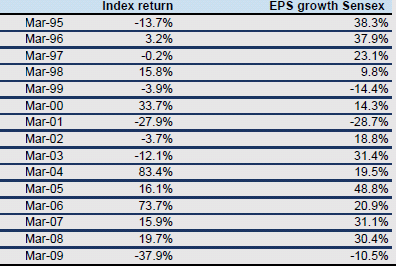
In the table above, data suggests that EPS usually grows 15%-20% in the year following a declining profit year in the market. However, EPS growth would be higher if the survivorship bias in the index was adjusted.
Will history repeat itself? We think so - particularly if the country has better governance and global factors are not disabling.
For our market P/E target, we are assuming a relatively modest expansion of P/Es from the current 15.5x one-year forward to 17-19x one- year forward as investors’ increase their appetite for risk. This is the normal trend 12 months from the bottom of every past cycle.
Clear picture will emerge not just after the Budget presentation but after Q1-FY10 management guidance. Long Term, stay bullish and take the opportunity to invest on every dip.
20 Year Bull + Bear Market Duration

Will the current 14 week rally fizzle out ? here is a Graph which shows historical data from 1990 to 2008 on the duration and Rise / Fall of SENSEX during Bull / Bear market.
So do we think this rally will end here ?
We do not know if this will be the case. Indian markets have materially outperformed, emerging market returns YTD. But this has happened repeatedly in the recent past.
We are concerned that the Indian market has moved up too much too fast. But we believe resistance is futile. It is extremely unusual for a market's rally to fizzle out so soon. The average bull market in India lasts for 53 weeks. In a world beset with an ever-increasing speed of response, such moves might be shrunk and play out over shorter periods. But 12-14 weeks is just too short a time for a market rally to end according to the above data.
Ya, I know it is extremely confusing as earnings don't justify the market levels yet.
Monday, June 8, 2009
Market hits Rs 50-trillion mark; attracts one lakh new investors
The ongoing surge in the stock market has pushed the shareholders' wealth past Rs 50,00,000 crore mark -- in the process bringing in A total of about 1.2 lakh new stock market investors opened their demat accounts, which is necessary to trade in equities, during the month of May, according to data available with the two depositories, National Securities Depository Ltd (NSDL) and Central Depository Services Ltd (CDSL).
This has increased the total number of demat accounts in the country to over 1.5 crore.
The market experts believe that the inflow of a large number of new investors into the market could be attributed the sharp surge in the recent months as well as expectations for revival of the IPO market with some fundamentally-sound public issues by the government-run companies.
The total investor wealth, measured in terms of cumulative market capitalisation of all the listed companies, has soared to about Rs 51,00,000 crore. This represents a gain of about Rs 23,00,000 crore from the level seen in later October last year, although it is still about Rs 20,00,000 crore below the peak seen in January 2008.
With the benchmark Sensex hitting its record high of 21,206.77 points on January 10, 2008, the total investor wealth had risen to a high of about Rs 72,00,000 crore at that time. However, a sharp meltdown thereafter pulled the Sensex to below 8,000-mark in late October 2008.
Since then, the Sensex has nearly doubled and has regained 15,000-point mark. Out of the total gain of about 7,500 points in the benchmark Sensex since its 52-week low of 7,697.39 points on October 27, 2008, nearly half the gain has materialised in the past one month alone.
Coinciding with the rally in the stock market, which in turn was partly fuelled by the new government promising speedier economic reform process and also disinvestment in some PSUs through IPOs, the total number of demat accounts in the country swelled by over one lakh over the last month.
"The recovery of the secondary markets would have encouraged many investors who were waiting on the sidelines during 2008 market fall. Also, the upcoming IPOs can also be another reason," SMC Capitals equity head Jagannadham Thunuguntla said.
Expressing similar views, Bonanza Portfolio's assistant vice president (equity research), Avinash Gupta said that the recent rally in the market and election results have improved the sentiment of the investors.
As per the CDSL figures, the total demat accounts increased to 56.19 lakh at the end of May from 55.64 at the end of April.
Similarly with NSDL, such accounts increased to 97.64 lakh at the end of the last month from 97.15 lakh at the end of April.
During the month, the Sensex climbed more than 28 percent in its strongest monthly performance in about 17 years.
This has increased the total number of demat accounts in the country to over 1.5 crore.
The market experts believe that the inflow of a large number of new investors into the market could be attributed the sharp surge in the recent months as well as expectations for revival of the IPO market with some fundamentally-sound public issues by the government-run companies.
The total investor wealth, measured in terms of cumulative market capitalisation of all the listed companies, has soared to about Rs 51,00,000 crore. This represents a gain of about Rs 23,00,000 crore from the level seen in later October last year, although it is still about Rs 20,00,000 crore below the peak seen in January 2008.
With the benchmark Sensex hitting its record high of 21,206.77 points on January 10, 2008, the total investor wealth had risen to a high of about Rs 72,00,000 crore at that time. However, a sharp meltdown thereafter pulled the Sensex to below 8,000-mark in late October 2008.
Since then, the Sensex has nearly doubled and has regained 15,000-point mark. Out of the total gain of about 7,500 points in the benchmark Sensex since its 52-week low of 7,697.39 points on October 27, 2008, nearly half the gain has materialised in the past one month alone.
Coinciding with the rally in the stock market, which in turn was partly fuelled by the new government promising speedier economic reform process and also disinvestment in some PSUs through IPOs, the total number of demat accounts in the country swelled by over one lakh over the last month.
"The recovery of the secondary markets would have encouraged many investors who were waiting on the sidelines during 2008 market fall. Also, the upcoming IPOs can also be another reason," SMC Capitals equity head Jagannadham Thunuguntla said.
Expressing similar views, Bonanza Portfolio's assistant vice president (equity research), Avinash Gupta said that the recent rally in the market and election results have improved the sentiment of the investors.
As per the CDSL figures, the total demat accounts increased to 56.19 lakh at the end of May from 55.64 at the end of April.
Similarly with NSDL, such accounts increased to 97.64 lakh at the end of the last month from 97.15 lakh at the end of April.
During the month, the Sensex climbed more than 28 percent in its strongest monthly performance in about 17 years.
Subscribe to:
Posts (Atom)