Showing posts with label BRIC. Show all posts

Sunday, November 29, 2009

BRIC markets lead the surge

India stands at 10th place with 87% return in 2009.

The BRIC magic has worked this calendar year too with all four countries – Brazil, Russia, India and China – placed among the top 15 in the performance table.

Brazil’s Bovespa index has returned 142 per cent in dollar terms since the beginning of this year and is placed at the top of the returns table containing leading global benchmarks. Russia’s RTS Index comes third with 121 per cent return. India’s Sensex is placed at the tenth spot with 87 per cent gains and China’s Shanghai Composite Index is in the fourteenth place with 74 per cent.

China’s benchmark has slipped five places from the ninth position it was at, towards the end of last week following the sell-off in Chinese stocks this week after their banking regulator asked Chinese banks to improve their capital adequacy ratios.

It is not just the BRIC markets but the entire emerging market universe that has returned stellar gains this year. The indices yielding 3-digit returns and placed among the top ten gainers among global benchmark indices include Peru Lima Index, Jakarta Composite Index and Argentina’s Merval index.

Developed Market indices have yielded relatively lower returns with the Dow returning only 19 per cent this year and the UK’s FTSE and Germany’s DAX returning less that 40 per cent.

The gains in BRIC markets was driven by global funds moving in to these equities once the dollar began its steep decline since April this year. With the waning of fears of a prolonged global recession from the second quarter of 2009, risk appetite returned; leading money back to riskier asset classes such as emerging market equity.

The rapid economic growth envisaged in the BRIC economies in the years ahead has also been a strong factor in attracting funds. IMF, in its world economic outlook has noted that after contracting by about 1 per cent in 2009, global activity is forecast to expand by about 3 per cent in 2010.

The rebound is to be driven by China, India and a number of other emerging Asian countries. Organization for Economic Co-operation and Development (OECD) has echoed this sentiment in its semi-annual outlook, expecting China and India and Brazil to grow by 10-, 7- and 5 per cent in 2010. The report expects Russia’s turnaround to be even more dramatic.

Strength in the currencies of Brazil, India and Russia since March has also been an incentive for foreign funds, since their returns are enhanced by currency gains. Brazilian ‘Real’ has appreciated 26 per cent this year while the Indian Rupee is up 4 per cent.

The out-performance of emerging markets and the BRIC quartet in 2009 is also due to the fact that their equity markets had a relatively benign first quarter. Most of the emerging market benchmarks including India did not re-test their October 2008 lows, while the Dow dived 26 per cent in the first three months before turning around.

Saturday, November 7, 2009

Crack emerging in the BRIC

In economics, BRIC is an acronym that refers to the fast-growing developing economies of Brazil, Russia, India and China.

In this article, I have reviewed the main indices of BRIC nations and guess what’s the outcome - there is a clear crack that has emerged in BRIC block. The crack sadly is because of Indian market. Every other market just looks fine :-(

Brazil: Takes support at 50 dma

Brazil has been one of the strong markets this year - thanks to massive rise in commodity prices and lots of +ve sentiment towards Brazil. Sometimes, you have everything going your way…Brazil also won the 2016 Olympic bid.


Source: www.stockcharts.com

Russia: Doing well and continues to trade above 50 dma

I hope I have used the right index for Russian market. I always get confused on this market.


Source: www.stockcharts.com


INDIA: Conclusive Breakdown below 50 dma/100 dma

There is a saying - when a momentum market breaks 50 dma - one should never take it lightly because the market setup is ripe for panic. Remember, how China cracked in August despite other Global markets holding up well. It appears it is the same pattern getting played out in India right now.


Source: www.stockcharts.com

China - Recovered from August massive sell off

One of the reasons why many market participants are hopeful on Indian market - China’s recent example. The Chinese Shanghai Composite index had a steep fall and then spectacular rise. The Chinese market is now well above 50 dma.


Source: www.stockcharts.com

Summary

All BRIC markets are in fine shape trading above 50 dma except Indian market. The most surprising part - there has been no global trigger for the sell off. The sell off argument - Disappointing earnings + Steep Valuation was perfect setup for fall

Indian market more aligned to US market

S&P 500 has also cracked below 50 dma. But, thankfully, there has been no follow through selling. The joker in the pack - US Dollar. What USD might do from current levels will decide the direction of S&P 500?


Source: www.stockcharts.com

Looking Ahead:

Indian market is oversold but that is no guarantee for bounce. It all depends on what USD, S&P 500 does from here. One thing is certain - Indian market is technically very weak and hence on any sell off in S&P 500 - Indian market might get hammered some more. It’s time to be careful both on long as well as short side. SHORT Side because we are so oversold; and LONG side because we are technically so weak at current juncture.

Monday, August 31, 2009

Can the Brics bounce back?

If you're not invested in Brics, you could be forgiven for wondering what you're missing out on. But it's simply an acronym for the countries Brazil, Russia, India and China which were identified in 2001 as being the leading nations among a group of emerging economies.

The term BRIC was coined by Goldman Sachs's head of global economic research, Jim O'Neill. He forecast that the countries' GDP growth could outpace the rest of the world, with the GDPs of China and India in particular set to surpass those of the major Western economic powers and dominate the global economy within 50 years.

The theme was taken up by others, leading to a wave of Bric funds being launched. The countries themselves joined the bandwagon, holding the first Bric economic summit this summer in Yekaterinburg, Russia. But the countries have fairly little in common, beyond their size.

Brazil's economy, for instance, is based on agriculture as well as oil, while Russia likewise is an oil- and gas-rich nation. India's economic growth is based on IT and services – think of call centres – while China's manufacturing industry make it the world's biggest exporter. Investing in a Bric-based fund, then, means buying into the argument that these four emerging countries offer the best opportunities for growth despite their differences.

That's not a view that Threadneedle's head of global emerging market equities, Julian Thompson, subscribes to. "It's true that the rise of emerging markets will be extremely important, but we don't think it's a good idea for investors to be limited to the Bric countries. There are lots of countries with good prospects, such as Indonesia, so we think it's better to offer a general emerging markets fund."

Ben Yearsley of independent financial advisers Hargreaves Lansdown adopts a different approach. "While I think investors should have exposure to the Bric economies, I prefer buying funds invested in individual countries, rather than a broad-base emerging markets fund." Mr Yearsley invests in a Russia fund, a Latin America fund, several Chinese funds and an Indian one.

"Some of these economies offer the best growth potential for the coming decade," says Mr Yearsley. "They are generally not saddled with the problems associated with many of the more developed countries. For example, they don't have pensions problems because they don't have massively ageing populations. They don't have the banking problems of the West either."

Brics and emerging market funds could form up to 25 per cent of an investor's portfolio for the foreseeable future. His recommendations? "If you want a Bric fund, use Allianz Bric Stars. If you want an emerging markets fund, use First State Global Emerging Markets Leaders. If you want individual funds, I'd go for Jupiter China, First State Latin America, First State Indian Subcontinent and Neptune Russia and Greater Russia."

Of the four Bric countries, Brazil is favoured by Adrian Lowcock of advisers Bestinvest. "The Brazilian economy is defined by the commodities industry and in particularly oil. The stock market is dominated by two companies which operate in the oil sector. Therefore, to some extent, investment into a Bric fund will be influenced by the performance of that sector; with Russia and Brazil on the supply side with China and to a lesser extent India providing the demand." He also highlights the First State Latin America as a way to profit from the potential growth. "It's a new launch so there is not much to report in terms of performance figures; however, it has returned 17 per cent in three months," he points out.

But investing in emerging markets is not for the faint hearted. "You can make a lot of money in emerging markets but you can also lose it in double quick time," Darius McDermott, managing director of Chelsea Financial Services, said. "Last year, for example, the stock markets in the developed nations fell 30 per cent but emerging markets more than 50 per cent. We give investments a risk rating between one and 10: one is the least risky and 10 the most. Emerging markets are definitely a 10. You have the potential for sharp currency moves eroding returns, geopolitical risks and, to be frank, fraud in these economies," Mr McDermott said. Only those investors with money already in savings accounts and in UK stock market funds or corporate bond funds should consider taking the emerging markets plunge.

"You have to build your way up from cash through UK funds, and only when you have substantial holdings should you consider emerging markets," Mr McDermott said. What's more, for those nearing retirement who cannot afford to remain invested for the long term, it may be best steering clear of emerging markets. In fact, many independent financial advisers reckon that investors should have a maximum of between 5 and 10 per cent of their portfolios in these high-risk funds. However, a smaller band of IFAs think investors would be wise to invest more as the long-term economic story of countries such as Brazil, India, China and Russia is a good one. "It's all about your attitude to risk, but I know some clients who really believe in these countries and are heavily invested," Mr McDermott said.

Brazil

Economic growth in Brazil is not as impressive as that recorded by China. However, the South American giant has fared better than expected in the face of the recession gripping Europe and America. “This year we expect growth in Brazil to be flat, but that is no bad thing. Crucially, commodity prices, on which the economy relies heavily, have bounced back and the consumer sector looks robust without high levels of personal debt or inflation,” said Bryan Collings, the manager of Hexam Capital’s Emerging Markets Fund.

Investors should have a “healthy dose of Brazil” in their portfolios, added Mr Collings, as share prices could be inflated by an influx of US-based investors. “More US cash is now going to Brazil than India and this is helping transform the stock market and boost the domestic investment culture.” However, this is not to say that there aren’t dangers inherent to investing in Brazil. “Commodity prices are key to the prospects of the economy, which makes it a little vulnerable, but with China still going ahead, there is a floor under those commodity prices,” Mr Collings said.

Russia

At the start of the year, with the Russian stock market nose-diving, there were those who thought Russia should be removed from the exclusive Bric club. Jim O’Neil from Goldman Sachs, who coined the term Bric, was one who questioned Russia’s right to be considered an emerging economic powerhouse rather than a perennial basket case. Bryan Collings of Hexam Capital said: “The main problem with Russia is the volatility. There can be dramatic rises and falls and that frightens some investors. The economy is dependent on commodity prices and often, when these fall, you see selling of the stock market. Unlike in the West, where you have big pension and investment funds that buy when share prices fall, in Russia there is no natural brake. As a result, when prices fall, it can be substantial and fast.” But if the world economy does pick up speed next year, Russia could be in a strong position. “

With its excellent natural resources and large population, Russia is well placed for outperformance as the world economy recovers,” Mr Collings said. “It may be riskier than the other Bric countries, but that can be a good thing if it’s within the confines of a larger emerging-markets or Bric fund.”

India

Like China, India seems to be successfully riding out the world economic storm. The key is that India has a balanced economy with companies able to appeal to a strong domestic market when its exports start to dip. “A lot has to do with the growth of the middle-class, educated workforce and infrastructure investment,” said Charlie Awdry from the Gartmore emerging markets team. And the latest signs are that the country’s consumers have continued to spend. “After a brief blip, car and motorcycle sales are on the up again, interest rates are low and business can find the credit it needs to invest,” said Teera Chanpongsang, the manager of Fidelity’s India Focus fund. In addition, the Indian government is moving to liberalise the economy further and reduce the budget deficit. But India’s stock market relative to the other Bric countries is quite expensive, with share prices trading around 15 times company earnings. “The Indian stock market is at a premium but I expect a lot of companies to upgrade their earnings expectations which should balance this out. Overall, India has been one of the best performing emerging markets over the past 10 years, but a long-term approach has to be taken,” Mr Chanpongsang added.

China

China has a massive population and has toppled the US as the world’s largest exporter. Recent figures suggest that the Chinese economy has weathered the worst of the world downturn and is returning to its near double-digit growth. “The long-term economic drivers, such as demographics and infrastructure, are all in place and they’ve been supplemented by the fiscal stimulus package the Chinese government put together last November,” said Pinakin Patel, a client portfolio manager at JP Morgan.

But there remain worries that the country is too in thrall to state interference. “There is no doubt the state is highly involved in the day-to-day running of people’s lives, but having the government at the helm of economic growth has been positive. It has been able to push through progress reasonably quickly,” Mr Patel said. Martha Wang, a portfolio manager at Fidelity’s China Focus fund, said there should be further positive effects from the stimulus measures. “But stock markets in China are likely to stay volatile in the near term as the global economic and investment outlook is still uncertain,” she warned. “Chinese companies could outperform world equities over the longer term, given China’s structural growth potential.”

Wednesday, June 24, 2009

Emerging-market stocks will advance 32 per cent


Developing-nation stocks may rise 32 percent in the next 12 months as a faster-than-expected earnings recovery fuels a long-term bull market, Morgan Stanley said.

The MSCI Emerging Markets Index may climb to 985 by June 2010 from its closing price of 743.72 yesterday, Jonathan Garner, Morgan Stanley’s chief Asian and emerging-market strategist, wrote in a research note. Profits will rebound 28 percent next year after a 15 percent slide in 2009, Garner wrote. That compares with his earlier forecast for a 20 percent gain in 2010 and a 25 percent drop this year.

The London-based strategist still reduced his recommended allocation to developing-nation equities, saying he’s “tactically cautious” because the global economic recovery may stall. The MSCI gauge may slide as much as 33 percent from its 2009 high during the next three months as weaker economic data from China and the US spark a “correction,” Garner wrote.

“We continue to believe that Asia and emerging-market equities are in a secular bull market,” Garner wrote. Still, “we would not chase the market here over the summer months.”

The 22-country benchmark surged 55 percent from February through May, a record three-month advance, on speculation that earnings will rebound as the global recession eases. The rally stalled this month as valuations reached the most expensive level since December 2007.

‘Correction’
Garner’s previous forecast for the MSCI gauge was for a rally to 810 by the end of 2009. He reduced his recommended equity allocation to 54 percent of an emerging-market portfolio from 56 percent and advised investors to increase cash holdings to 5 percent from 3 percent.

Garner’s call for a “correction” in emerging-market stocks contrasts with a more bullish short-term outlook from Adrian Mowat, JPMorgan Chase & Co.’s Hong Kong-based chief Asian and emerging-market strategist.

Mowat wrote in a report that he sees “no obvious fundamental triggers for correction” and investors should take advantage of this month’s retreat in stocks to “position” for further gains through the end of the year.

“Potentially, we are in a powerful rally in emerging- market equities,” Mowat said.

Developing nations may grow their share of global gross domestic product to about 35 percent by next year from 20 percent a decade ago, Garner said. That will help boost emerging markets’ weightings in global stock indexes, he added.

“We anticipate that demographic trends and the adoption of the market economy in most EM countries will sustain the recent trend towards a more EM-centered global economy,” Garner wrote.

The authors are Bloomberg News columnists The opinions expressed are their own


Wednesday, June 10, 2009

Positive Signs for Emerging Markets India, China and Brazil

Perhaps talk of a full economic recovery is premature as global unemployment issues will continue well into 2010, however many investors are again viewing their chances of growth in emerging markets as better than those of the United States or Europe. In particular, India, China and Brazil stock markets have shown leading gains since March 2009.

As a result, the Indian Nifty stock index has jumped by 64% in the last three months. China CSI 300 index of shares in Shanghai and Shenzhen have risen 37% and Brazil’s Bovespa increased 41%

over the same period. By comparison, the Standard & Poor’s 500’s gained about 28% returns.

Although these emerging markets may face some issues, by and large they are manageable issues. For example, the Prime Minister of India, Manmohan Singh said Wednesday while in the Lok Sabha that India will achieve economic growth of at least 7% this fiscal year.

On Wednesday, the S&P CNX India Nifty rose 121 points or 2.73% to 4,551 on the Bombay Stock Exchange - Twenty eight out of 30 India’s Sensex stocks ended in the green including DLF(up 10.07%), Jaiprakash(up 8.18%), Reliance Communication(up 7.37%), Larsen & Toubro(up 6.39%), Ranbaxy (RBXLF.PK) up 6.37%, Mahindra & Mahindra(up 6.34%), TCS(up 5.95%), Tata Power(up 5.55%), Tata Steel (TATLY.PK) up 5.28%, Hindalco(up 4.53%) and ACC(up 4.47%) were the top gainers. Grasim Industries (GRSXY.PK) and NTPC ended down around 0.60% each.

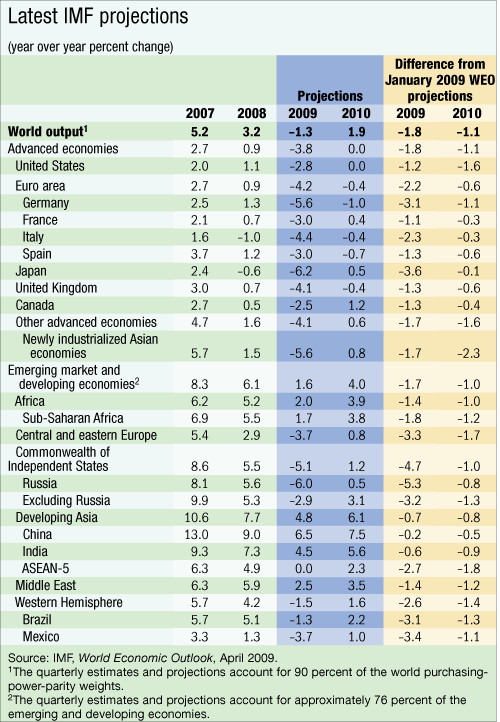
Additional support for this emerging market growth is found in the recent IMF (World Economic Outlook Report, April 2009) that calculates global growth is projected to reemerge in 2010, but at 1.9 % rather sluggish relative to past recoveries. The IMF states that global growth in 2010 would come entirely from the emerging markets and developing countries such as India, China and Brazil, at an average of 4%, while developed countries' such as the U.S. and Europe economies are expected to remain stagnant or less until at least 2010.

Click to enlarge:

Today, the MSCI Brazil Index (EWZ) closed at $55.63. Brazil Bovespa Stock Index is up 54%. EWZ June option implied volatility is at 58 July is at 53; below its 26-week average of 61.


Across the world, banks are limiting access to credit (and will continue to do so) as the overhang of bad assets and uncertainty about which institutions will remain solvent keep private capital on the sidelines. Funding strains have spread well beyond short-term bank funding markets in advanced economies. Many nonfinancial corporations are unable to obtain working capital, and some are having difficulty raising longer-term debt.

The broad retrenchment of foreign investors and banks from emerging economies and the resulting buildup in funding pressures are particularly worrisome. New securities issues have come to a virtual stop, bank-related flows have been curtailed, bond spreads have soared, equity prices have dropped, and exchange markets have come under heavy pressure.

Beyond a general rise in risk aversion, this reflects a range of adverse factors, including the damage done to advanced economy banks and hedge funds, the desire to move funds under the ‘umbrella’ provided by the increasing provision of guarantees in mature markets, and rising concerns about the economic prospects and vulnerabilities of emerging economies.

On the upside, however, bold policy implementation that is able to convince markets that financial strains are being dealt with decisively could revive confidence and spending commitments. But even when the crisis is past, there will be a difficult transition period, with output growth appreciably below rates seen in the recent past.

The greatest policy priority at this juncture is financial sector restructuring. Convincing progress on this front is crucial for an economic recovery to take hold and would significantly enhance the effectiveness of monetary and fiscal stimulus.

The critical underpinning of an enduring solution must be credible loss recognition on impaired assets. To that effect, governments need to establish common basic methodologies for the realistic valuation of securitized credit instruments, which should be based on expected economic conditions and an attempt to estimate the value of future income streams.

Recapitalization methods must be rooted in a careful evaluation of the long-term viability of institutions, taking into account both losses to date and a realistic assessment of the prospects of further write downs.


Thursday, May 28, 2009

Indian stocks 2nd best performers among BRIC

Following a sharp recovery in the equity markets, Indian stocks have emerged as the second best performers as compared to their peers in three other BRIC nations -- Brazil, Russia and China -- giving close to 20 per cent return in April.

According to an analysis of MSCI Barra indices, a measure of returns from various stock markets across the world for foreign investors, Indian stocks have given the second highest return after Russia among the four BRIC countries during last month.

Indian stocks have provided a return of nearly 19.54 per cent in April, while China and Brazilian markets have given 10.87 per cent and 18.89 per cent respectively.

However, Russian equities have managed to outperform the Indian stocks in the month as it provided investors with a positive return of over 21 per cent, as per the analysis of performances of Morgan Stanley Composite Indices for various nations.

The 30-share benchmark index of Indian stocks, Sensex, gained close to 1,700 points in the month of April to settle at 11,403.25 points on April 29.

Indian stocks have even outperformed the MSCI Barra's emerging market index, which includes all the developing world markets, giving returns to foreign investors to the tune of 16.28 per cent in the month. After losing nearly 50 per cent in the past one year, Indian stocks have gained close to 18 per cent in the first four months.

Further, Indian equities have provided negative returns of over five per cent in the past three years, while taking into account the last five years, they had given positive 11.26 per cent returns and just about 12 per cent in the 10 years period.

Besides, the emerging markets other than the BRIC nations have also performed significantly better in the past month with Indonesian stocks giving the highest returns of over 30 per cent in the period.

Other emerging markets which provided around 20 per cent returns in the period include -- Korea, Hungary, Turkey and Poland.

Meanwhile, the developed markets have also performed significantly better in the reviewed month with the US, Japan, Austria, UK giving returns between nine to 12 per cent.

The best performing developed markets in April were Finland (23 per cent returns) and Sweden (22 per cent).

Saturday, May 23, 2009

BRICS Are Back....The headlines are hard to ignore.

Every day, it seems, there's fresh news crossing the wire about yet another bailout or another outrageous government spending plan.

Well guess what that’s going to do to the value of the U.S. dollar? The greenback is losing more of its value against the euro, British pound, and even the Canadian dollar. And the more Washington spends, the worse it’s going to get.

For years, investment advisors have been telling you, "Diversify! Put part of your portfolio into international equities!" Well, they were right.

Over the past 10 years, the S&P 500 index has lost about 4% of its value each year. You would literally have been better off putting your money under the mattress than in the U.S. stock market.

Overseas the story was different. Granted, 2008 was an ugly year for everybody. But over the past 10 years, emerging markets like China, Brazil and India have delivered more than 6% annualized returns. Sure, it’s been a bumpy ride, but at least investors have been adequately paid to take the risk.

Let me put it another way. A $10,000 investment in U.S. stocks 10 years ago would have dwindled to a mere $6,500 or so today. That same investment in emerging markets? Even after factoring in a horrible year in 2008, it would be worth more than $18,000.

The numbers just don’t lie--emerging markets were one of the best investments you could have made over the past decade. The bad news is that most folks missed out. They either didn’t know about the opportunities in emerging markets--or they were too busy looking for the next hot Internet stock to bother.

But here’s the good news. Emerging markets are starting to outperform again--and the case for investing in these countries is as strong as ever. It’s a rare second chance that you can’t afford to miss.

While the U.S. market struggles to regain its footing in 2009, international stocks are on fire yet again. Chinese stocks have gained more than 20% since the start of the year. Brazil and Taiwan are up about 40%. Even less exotic markets like Belgium, Denmark and Norway are sitting on healthy double-digit gains.

Meanwhile, the Dow Jones is having trouble staying in positive territory.

See if you can guess what the best-performing stock market has been in 2009....Would you believe it’s Russia? Yep, it’s up more than 50%!

Of course, international markets haven’t been immune to the global economic recession. But a lot of countries were in better shape than the U.S. before the trouble began. And many of these same countries, particularly in emerging markets, are investing a whopping amount of money in infrastructure and other big economic stimulus plans. Unlike Uncle Sam, however, these countries can actually afford it!

The Economist, a sober publication that knows its global financial history well and eschews hyperbole, notes that "never before has infrastructure spending been so large as a share of World GDP." Not even during the Industrial Revolution.

The message is clear: If you haven't been investing overseas, you have been missing out. Big time.

In fact, over the past five years, the performance of U.S. stocks ranks close to the bottom among the world's biggest economies.

Bottom line: International stocks are no longer just something to dabble in anymore--they have become absolutely vital to protecting your wealth.

Trouble is, there are a staggering 40,000 publicly traded equities to choose from worldwide. And holding the right ones in your portfolio can make an enormous difference to your personal wealth.

How on earth do you know which ones to buy?

Unfortunately, you can't simply tell your broker "buy me some international funds or stocks," close your eyes, and hope for the best. And how do you know which countries are heading into raging bull markets...and which are turning into bears?

Good luck asking your broker. Most American stock brokers would have enough trouble just finding some of these markets on a map!