
Showing posts with label India. Show all posts

Sunday, May 9, 2010

Indian Stock Market Detailed Technical Analysis with Chart studies

May 08, 2010
As we have been stating repeatedly in our previous analysis, this week we were expecting negative divergence to kick in, and it clearly did. Nifty failed every move to cross the middle line of the BB channel as can be seen from the chart below. Nifty just followed the wrath of global markets to the downside with no pause at all.

This week nifty finally broke down from the tight trading range pattern. Nifty lost nearly 5% for the week. However this performance was better compared to S&P 500 in the US that lost nearly 6.5%. This shows the strength in the Emerging markets as investors are not really keen on selling into panics. That doesn't necessarily mean nifty cannot or will not go down further. The Rate Of Change (ROC) also matters a lot as it shows the underlying confidence and strength in a stock/index.

Technically Speaking:

Take a look at the Daily Nifty chart below.

The above chart uses TD Demark indicators extensively.

Positives:

  1. None in particular.
  2. Historically, each time TD Plurality indicator moved below -2 and above it, market has found a short term bottom as you can see from the chart
  3. TD REI sort of developing positive divergence.
  4. May be too oversold as Nifty kept challenging the lower BB each and every day.
Negatives:
  1. RSI going down the hill and pretty fast. Not good at all. Add to it, the negative divergence and downtrending resistance/slope.
  2. Way below the middle BB line means more downside action possible. As you can see, once nifty crosses this line, it goes on in that direction for at least a few more sessions.

Next Week:

Weekly chart is as bad as the daily one. Nifty broke below middle BB line with a brute force and a big red candle. MACD histogram also moved to the negative territory.

The chart below is the ratio chart of Indian VIX (Volatility index) to Nifty. This chart shows the correlation between Volatility and the moves in Nifty. The lower this chart, the higher the chances for Nifty to move up and vice-versa. We clearly have been stressing on the importance of this ratio chart staying above 0.0040 as being extremely negative for nifty. We also have been showing bunch of positive divergences on this chart that would lead to downside on nifty. And that worked out as predicted, this week.

After a long while, this ratio has actually managed to close outside of the Upper BB. This means, there is much more downside in nifty that is expected. However, there may be a bounce in the next few sessions owing to the extreme overbought nature of this ratio chart AND oversold nature of indices.

Trades for Next week

Last week we clearly stated that If you have already initiated a short position, trade with strict SL and that it was NOT a good time to go long. Our stance this week hasn't changed a bit. Friday US markets closed in red and which would mean that there is a high potential of nifty opening lower. However, we expect some bounce in the first part of next week owing to the extreme oversold nature in the very short term (VST). It may be a good idea to lighten some of your short positions and wait for the next opportunity to either go short or long. Do not go long or short in the next week, unless your trade duration is intraday or at most 1-2 days.


Wednesday, June 10, 2009

Positive Signs for Emerging Markets India, China and Brazil

Perhaps talk of a full economic recovery is premature as global unemployment issues will continue well into 2010, however many investors are again viewing their chances of growth in emerging markets as better than those of the United States or Europe. In particular, India, China and Brazil stock markets have shown leading gains since March 2009.

As a result, the Indian Nifty stock index has jumped by 64% in the last three months. China CSI 300 index of shares in Shanghai and Shenzhen have risen 37% and Brazil’s Bovespa increased 41%

over the same period. By comparison, the Standard & Poor’s 500’s gained about 28% returns.

Although these emerging markets may face some issues, by and large they are manageable issues. For example, the Prime Minister of India, Manmohan Singh said Wednesday while in the Lok Sabha that India will achieve economic growth of at least 7% this fiscal year.

On Wednesday, the S&P CNX India Nifty rose 121 points or 2.73% to 4,551 on the Bombay Stock Exchange - Twenty eight out of 30 India’s Sensex stocks ended in the green including DLF(up 10.07%), Jaiprakash(up 8.18%), Reliance Communication(up 7.37%), Larsen & Toubro(up 6.39%), Ranbaxy (RBXLF.PK) up 6.37%, Mahindra & Mahindra(up 6.34%), TCS(up 5.95%), Tata Power(up 5.55%), Tata Steel (TATLY.PK) up 5.28%, Hindalco(up 4.53%) and ACC(up 4.47%) were the top gainers. Grasim Industries (GRSXY.PK) and NTPC ended down around 0.60% each.

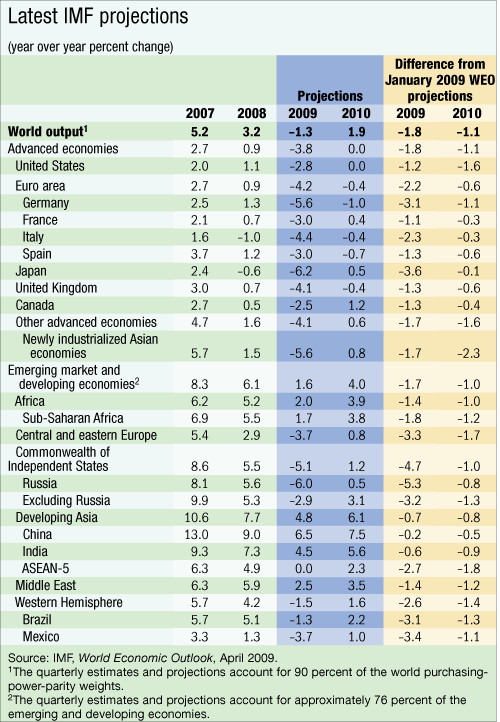
Additional support for this emerging market growth is found in the recent IMF (World Economic Outlook Report, April 2009) that calculates global growth is projected to reemerge in 2010, but at 1.9 % rather sluggish relative to past recoveries. The IMF states that global growth in 2010 would come entirely from the emerging markets and developing countries such as India, China and Brazil, at an average of 4%, while developed countries' such as the U.S. and Europe economies are expected to remain stagnant or less until at least 2010.

Click to enlarge:

Today, the MSCI Brazil Index (EWZ) closed at $55.63. Brazil Bovespa Stock Index is up 54%. EWZ June option implied volatility is at 58 July is at 53; below its 26-week average of 61.


Across the world, banks are limiting access to credit (and will continue to do so) as the overhang of bad assets and uncertainty about which institutions will remain solvent keep private capital on the sidelines. Funding strains have spread well beyond short-term bank funding markets in advanced economies. Many nonfinancial corporations are unable to obtain working capital, and some are having difficulty raising longer-term debt.

The broad retrenchment of foreign investors and banks from emerging economies and the resulting buildup in funding pressures are particularly worrisome. New securities issues have come to a virtual stop, bank-related flows have been curtailed, bond spreads have soared, equity prices have dropped, and exchange markets have come under heavy pressure.

Beyond a general rise in risk aversion, this reflects a range of adverse factors, including the damage done to advanced economy banks and hedge funds, the desire to move funds under the ‘umbrella’ provided by the increasing provision of guarantees in mature markets, and rising concerns about the economic prospects and vulnerabilities of emerging economies.

On the upside, however, bold policy implementation that is able to convince markets that financial strains are being dealt with decisively could revive confidence and spending commitments. But even when the crisis is past, there will be a difficult transition period, with output growth appreciably below rates seen in the recent past.

The greatest policy priority at this juncture is financial sector restructuring. Convincing progress on this front is crucial for an economic recovery to take hold and would significantly enhance the effectiveness of monetary and fiscal stimulus.

The critical underpinning of an enduring solution must be credible loss recognition on impaired assets. To that effect, governments need to establish common basic methodologies for the realistic valuation of securitized credit instruments, which should be based on expected economic conditions and an attempt to estimate the value of future income streams.

Recapitalization methods must be rooted in a careful evaluation of the long-term viability of institutions, taking into account both losses to date and a realistic assessment of the prospects of further write downs.


Thursday, June 4, 2009

India is entering a long-term bull run

Rediff.com caught up with Reliance Capital Asset Management chief executive officer Sundeep Sikka at his Churchgate, Mumbai office. Sikka, who heads Reliance Mutual Funds, explained the company's continuing success, the state of the Indian mutual fund industry and what potential investors should look for in the future.

'We're entering a long-term bull run'

How badly has the global financial meltdown affected India's mutual fund industry? How did it affect Reliance mutual fund?

I'll put it like this: the previous fiscal year, 2008-2009, has shown that India is neither insulated nor isolated from outside forces. Now, we are truly part of the global economy. So of course there were effects, as you saw with dramatic falls in the markets.

But I'd also like to mention that India is an amazing domestic consumption story. We still have 6 per cent annual growth. If this 6 per cent growth was happening in a Western country, they'd be worried about the economy overheating! So you have to consider that when you hear people say, "Oh, the Indian economy is slowing down."

We, as a fund house, have been very consistent. During the financial crisis, we were able to use cash as a hedge against the worst effects.

Do you think the world economy is on a way to recovery? Or is it just a temporary phase? How about in India? Is the worst over? How do the Lok Sabha poll results factor in?

To understand what's happening, you have to first understand what happened. Major banks in the West failed and liquidity evaporated. This had far-reaching effects all around the world.

But things are now stabilising and improving, especially in India and in certain other Asian countries, like Indonesia. There are positive signs even in the West, too. On Monday, General Motors declared bankruptcy, but the markets hardly reacted at all. If this had happened six months earlier, there would have been a major negative reaction. So things are looking better.

In India, we certainly have seen an upturn recently. While it's impossible to predict the exact direction things will take, the signals are very encouraging. We believe that, at least in India, things are definitely going to keep improving.

And while the upturn cannot be solely attributed to the Lok Sabha poll results, the government being stable is definitely contributing to a bull run. Our view is that we're entering a long-term bull run. It's the right time to be in India.


What are the signs that India is already on its way to recovery?

Go to the airports, they're crowded. People are still flying. Go to the malls, they're crowded. People are still shopping. Go to the showrooms, they're crowded. People are still buying cars. You have to be able to gauge the pulse of the market. Some times, we in the industry and also those in the media, lose sight of this pulse. And the current pulse shows that we are most definitely not in a recession.

So who gets the credit for India averting a major crisis?

We need to compliment the regulator, for controlling things very nicely. The regulator acted prudently and conservatively. Also, India in general has a more conservative investing culture. You must remember: when the distance between a tangible asset and its accompanying financial instrument increases, it can lead to big problems. That in large part is what happened in the West. There were layers and layers between tangible assets and the related financial instruments. That can be dangerous.

In India, we don't have this phenomenon, so we were shielded from some of the worst effects.

'Our biggest opportunity is in infrastructure'


What are your expectations from the new finance minister? And what is your Budget wish-list as CEO and an individual taxpayer?

We have a dream team in place. It's a very knowledgeable group with a clear mandate from the voter. So I expect great things. As a CEO and as an individual, I would most want to see the government focus on infrastructure and education. Those are the two most important issues, in my mind. You work on those areas and it could have a long-reaching positive effect for the country and the economy.

As per the World Bank, India has a huge, almost unprecedented opportunity to invest in infrastructure. So this must happen. There's a lot of opportunity in public transportation. Look at what Delhi's achieved with the metro (rail), and now what Mumbai is looking to do with the Bandra-Worli Sea Link and the upcoming Metro. So to me it's clear that our biggest opportunity is in infrastructure.

What is your message to prospective investors? What points should they keep in mind while buying mutual funds?

One message: Keep investing. Be a long-term investor with a plan and a vision, not a short-term investor.

Also, you should never have 100% equity or 100% debt. You need a healthy balance to maximise your wealth growth potential.

Review your portfolio regularly, but don't watch it obsessively. I honestly believe that, unless you do it for a profession, stay close to the financial world, but not too close.

It's important to go to the experts. You can diagnose yourself when you're sick. You can give yourself medicine. And sometimes it works. But you'd be smart to go to the doctors, because one mistake can hurt you tremendously. It's the same way with investing. One bad mistake can mean financial suicide. So it's important to go to the experts.

Economists raise growth forecasts after elections

Prospects of a stable government at the Centre have prompted at least six economic forecasters to raise their growth estimates for the current fiscal, citing lower-than-expected political risk after the recent general elections.

With the Congress-led United Progressive Alliance coming to power with less than half the number of allies than it had before and the four Left parties out of the picture, the average economists' forecast for GDP growth in 2009-10 has increased over half a percentage point to 6.35 per cent after the election results were announced.

Before the elections, growth was projected at 5.61 per cent, according to data collected from eight economic forecasters. Two forecasts were not revised (see table).

Looking up (Economists' forecasts for India's GDP)
Time periodBefore ElectionsAfter Elections
Average5.616.35
Morgan Stanley5.806.20
Nomura5.306.30
Kotak5.506.00
Barclays5.507.00
HSBC6.206.20
Goldman Sachs5.805.80
Bank of America- Merrill Lynch5.306.30
Macquarie Securities5.507.00
Source: Respective research reports

"The political risk has been mitigated with a stable government at the Centre," said Subir Gokarn, chief economist with Standard & Poor's, a rating agency. "A stable government will speed up certain investment decisions so people would be more positive about the future."

Although S&P - which downgraded India's sovereign rating outlook on account of the rising fiscal deficit in January 2009 - has not revised its growth estimate, others like Morgan Stanley, Nomura and Kotak Mahindra had all done so.

The prospect of higher political risk from a widely expected hung Parliament had prompted GDP projections for 2009-10 to be revised downwards.

"The election results will have a positive impact," said Saumitra Chaudhuri, an economist with rating agency ICRA Ltd [Get Quote] and member of the Prime Minister's Economic Advisory Council. He said the negative bias to growth will go out his earlier prediction of 7 per cent, with a range of half a percentage point.

These upward revisions are expected to have an impact on corporate investments, which were the main driver when the Indian economy grew at 9 per cent and above for three years till March 2008, contributing nearly 50 per cent of the expansion in output.

"Given that the UPA no longer needs outside support of the Left, it would now be able to continue with the reform process unhindered," wrote Citigroup analysts in a recent research note.

The four Left parties had voted with the government in the Lok Sabha the last time and had been instrumental in blocking a significant amount of economic reform.

"While trends in consumption are likely to sustain, given that the government had already implemented fiscal stimulus measures over the past year, the UPA's clear majority would now spur investment growth as well," the Citigroup analysis added.

There is now a heavy weight of expectation that the government, free of Left, will push economic reforms in areas like banking, insurance and capital markets that will enable greater capital flow into the economy.

Tuesday, May 26, 2009

Next decade belongs to Indian and Chinese consumers: Report

The next decade belongs to Indian and Chinese consumers, forecasts a new economic outlook report.

Further, the US will see the return of inflation and stocks and resource prices will boom as Asian consumers splurge in the next decade, says the new economic outlook report by Canadian Imperial Bank of Commerce (CIBC) here Monday.

Calling the next decade 'the teenage years,' the report said that like teenagers, financial markets and the economy would be moody and unpredictable initially, but then grow and mature.

CIBC chief economist and report co-author Avery Shenfeld said: "The US, and perhaps to a lesser extent, Canada, will become a bit more China-like in the teen years. We will see more of a contribution from exports and related capital spending, and less from housing or consumption.''

Shenfeld expected greater consumer spending in regions, particularly China and oil-exporting countries, which ran "outsized savings rates over the past decade.''

A fall in the savings rate in the developing world could add far more to global consumption spending than will be lost in the adjustment to a higher savings rate in the US, and the developed world, the economist said.

The key driver in this, he said, will be a drop in the value of the over-inflated US dollar.
Expecting the US greenback to fall by 20 per cent, the Canadian economist said a weaker dollar will help unlock wallets overseas.

"Stronger currencies in East Asia and, if there is an un-pegging as we expect, in the Persian Gulf oil economies, will be one step towards improving the real purchasing power of consumers in these regions,'' he said.

"Moreover, the longer countries like China and India see improving economic conditions, the more households will be confident that their newfound wealth is not h ephemeral, allowing them to reduce precautionary savings,'' the Toronto banker added.

For the US, he said, a weaker dollar will be the key to promoting both exports and capital spending at home, by making "Made in America'' less of a cost disadvantage.

Ruling out tax hikes in the US to be the solution to the growing government debt, he said, "Letting inflation run at five per cent for a few years in the early part of the decade would go a long way to digging the US out of its debt mountain.

"Higher inflation would help stabilize or even boost house prices, key to allowing a return to positive home equity for those with mortgages that now threaten to exceed the house price.''