Showing posts with label Emerging market. Show all posts

Saturday, July 11, 2009

India is the bright spot

When it comes to investing, the key is to understand investor behaviour. And in recent times, the fear of uncertainty is preventing most high net worth individuals (HNIs) to make the best use of this opportunity, says a recent survey done by Barclays Wealth along with the Economist Intelligence Unit. The survey of 2,100 affluent investors indicated that when it comes to the fear of investing Indians are no different from the rest of the world.

Among Indians, while 80 per cent see this opportunity, only 16 per cent are willing to take more risk. Says Satya Bansal, Chief Executive, Barclays Wealth India: “There’s a clear dichotomy between investors’ belief and action.”

As the survey was conducted in April and May 2009, many of the 115 HNIs responded before the central government elections. Overseas investors are more bullish about India’s growth than Indians themselves.

About 45 per cent investors in the UK, 25.2 per cent the US and 28 per cent Chinese investors are confident on India as compared to 22 per cent Indian HNIs. Says Bansal: “It’s the overseas investors’ confidence in India combined with ample liquidity and low global interest rates that will drive FDI and FII investments in India.”

—Clifford Alvares

Monday, June 29, 2009

Emerging-market funds pulling out

Emerging-market stock funds lost $1.87 billion in the week ended June 24, the first week of net outflows since early March, on concern that a rebound in exports will be delayed, EPFR Global said.

Investors withdrew $660 million from funds investing in Asia excluding Japan and pulled $457 million from Latin American equity funds, the research firm said in a statement yesterday.

“Although we're still very positive on the prospects for emerging markets in the long term, their economies remain very precarious and it is difficult to see how they are going to quickly fill this hole that has been created by the collapse in exports,” said Peter Elston, a Singapore-based strategist at Aberdeen Asset Management, which oversees $30 billion in Asia.

The MSCI Emerging Markets Index has declined 5 percent from the eight-month high on June 1. The gauge has climbed 34 percent this year as inflows from investors surged and stimulus plans from China to Brazil bolstered confidence.

“On average, the cumulative return of new moneys put into emerging-market funds since the third week of May have been flat to negative in dollar terms, which should temper enthusiasm about investors committing new funds to emerging markets in the near term,” Jonathan Garner, Morgan Stanley's chief Asian and emerging-markets strategist, said in a note.

South Korea, Mexico
Garner last week said the MSCI index for developing nations may climb to 985 in the next 12 months. He yesterday downgraded his ratings for South Korea, Turkey, Hungary and Israeli equities and raised its recommendation for Mexico, Indonesia and the Czech Republic.

The world economy will contract 2.9 percent this year, compared with a March forecast of a 1.7 percent decline, the World Bank said in a June 22 report, which led to a sell-off in global stock markets. Growth will be 2 percent next year, down from a 2.3 percent prediction, the Washington-based bank said.

The MSCI Emerging Markets Index dropped to as low as 718.56 on June 23, bringing its losses from its 2009 peak to 10 percent and marking the first so-called correction since developing- nation shares started rallying almost four months ago.

Outflows
The MSCI gauge was valued at 15.4 times reported profits at its peak this year, according to data compiled by Bloomberg. It closed last Thursday at 14.8 times.

Overall, equity funds tracked by EPFR globally posted outflows of $4.12 billion during the week, while money-market and US bond funds saw net inflows, the research company said.

The reversal “was most pronounced among Asia ex-Japan and Latin America Equity Funds,” said EPFR, a Cambridge, Massachusetts-based research company tracks funds with $10 trillion in assets. “Investors questioned where and when demand for their manufactured and commodity exports will pick up.”

China funds lost $262 million, the biggest weekly outflow since the first week of March, while those investing in the Greater China region posted net outflows of $175 million, EPFR said.

Brazil, Russia and India funds also posted net outflows even as funds focusing on the so-called BRIC markets took in more money, the statement said.

Wednesday, June 24, 2009

Emerging-market stocks will advance 32 per cent


Developing-nation stocks may rise 32 percent in the next 12 months as a faster-than-expected earnings recovery fuels a long-term bull market, Morgan Stanley said.

The MSCI Emerging Markets Index may climb to 985 by June 2010 from its closing price of 743.72 yesterday, Jonathan Garner, Morgan Stanley’s chief Asian and emerging-market strategist, wrote in a research note. Profits will rebound 28 percent next year after a 15 percent slide in 2009, Garner wrote. That compares with his earlier forecast for a 20 percent gain in 2010 and a 25 percent drop this year.

The London-based strategist still reduced his recommended allocation to developing-nation equities, saying he’s “tactically cautious” because the global economic recovery may stall. The MSCI gauge may slide as much as 33 percent from its 2009 high during the next three months as weaker economic data from China and the US spark a “correction,” Garner wrote.

“We continue to believe that Asia and emerging-market equities are in a secular bull market,” Garner wrote. Still, “we would not chase the market here over the summer months.”

The 22-country benchmark surged 55 percent from February through May, a record three-month advance, on speculation that earnings will rebound as the global recession eases. The rally stalled this month as valuations reached the most expensive level since December 2007.

‘Correction’
Garner’s previous forecast for the MSCI gauge was for a rally to 810 by the end of 2009. He reduced his recommended equity allocation to 54 percent of an emerging-market portfolio from 56 percent and advised investors to increase cash holdings to 5 percent from 3 percent.

Garner’s call for a “correction” in emerging-market stocks contrasts with a more bullish short-term outlook from Adrian Mowat, JPMorgan Chase & Co.’s Hong Kong-based chief Asian and emerging-market strategist.

Mowat wrote in a report that he sees “no obvious fundamental triggers for correction” and investors should take advantage of this month’s retreat in stocks to “position” for further gains through the end of the year.

“Potentially, we are in a powerful rally in emerging- market equities,” Mowat said.

Developing nations may grow their share of global gross domestic product to about 35 percent by next year from 20 percent a decade ago, Garner said. That will help boost emerging markets’ weightings in global stock indexes, he added.

“We anticipate that demographic trends and the adoption of the market economy in most EM countries will sustain the recent trend towards a more EM-centered global economy,” Garner wrote.

The authors are Bloomberg News columnists The opinions expressed are their own


Sunday, June 14, 2009

India among top 2 emerging markets for Yahoo!

Internet search giant Yahoo! on Sunday said India is one of the 'top emerging markets' and it would release a slew of products over next few months for further consolidating its position in the country.

"India is one of the top two countries in the emerging markets segment and holds a lot of promise for us ... Products developed in the Indian lab and centres abroad are part of the pipeline of innovative products that will help us in the Indian market," Yahoo! Head of Audience (Emerging Markets) Gopal Krishna told media.

He, however, declined to comment on the details of the products. "Innovations around mail, instant messenger and front page (landing page) would be prime focus areas. We would also look at news properties like News, Bollywood and Buzz," he said.

Emerging markets contributes up to 65 per cent to the total users for some of the key global Yahoo! properties and is the fastest growing region from business perspective as well, he added.

One of the leading properties/products is Yahoo! Cricket, which attracted 2.4 million unique users per month emerging as the top cricket site in India, according to Comscore April 2009 data.

In February this year, Yahoo! India had entered into a three-year partnership with the International Cricket Council (ICC), becoming the exclusive online partner for all ICC events, including ICC World Twenty20, ICC Champions Trophy and ICC Cricket World Cup.

It has also partnered with companies like LG, Pepsi, Maruti, Tata Xenon, Honda, ICICI, Citibank and Cisco for advertising on the microsite. Yahoo! India also has a two-year partnership with Reliance, Krishna said.

Yahoo! India is also focusing on building its mobile business in the country. It is working on developing products, apart from the ones available on web to build its presence on mobile websites.

"We are looking at presenting users with a experience that is different from using Internet on PCs. Apart from the usual things, we are looking at developing applications specific to mobile handsets as well," Krishna said, adding that the mobile segment also presents a good opportunity in terms of advertising.

Worldwide spending on mobile advertising is expected to reach USD 19 billion in 2012, while the APAC market is forecast to touch USD 6.9 billion, according to eMarketer (March 2008).

Wednesday, June 10, 2009

Positive Signs for Emerging Markets India, China and Brazil

Perhaps talk of a full economic recovery is premature as global unemployment issues will continue well into 2010, however many investors are again viewing their chances of growth in emerging markets as better than those of the United States or Europe. In particular, India, China and Brazil stock markets have shown leading gains since March 2009.

As a result, the Indian Nifty stock index has jumped by 64% in the last three months. China CSI 300 index of shares in Shanghai and Shenzhen have risen 37% and Brazil’s Bovespa increased 41%

over the same period. By comparison, the Standard & Poor’s 500’s gained about 28% returns.

Although these emerging markets may face some issues, by and large they are manageable issues. For example, the Prime Minister of India, Manmohan Singh said Wednesday while in the Lok Sabha that India will achieve economic growth of at least 7% this fiscal year.

On Wednesday, the S&P CNX India Nifty rose 121 points or 2.73% to 4,551 on the Bombay Stock Exchange - Twenty eight out of 30 India’s Sensex stocks ended in the green including DLF(up 10.07%), Jaiprakash(up 8.18%), Reliance Communication(up 7.37%), Larsen & Toubro(up 6.39%), Ranbaxy (RBXLF.PK) up 6.37%, Mahindra & Mahindra(up 6.34%), TCS(up 5.95%), Tata Power(up 5.55%), Tata Steel (TATLY.PK) up 5.28%, Hindalco(up 4.53%) and ACC(up 4.47%) were the top gainers. Grasim Industries (GRSXY.PK) and NTPC ended down around 0.60% each.

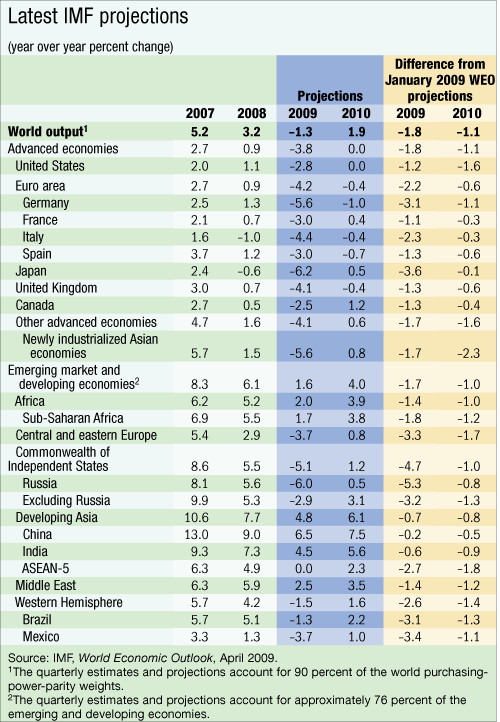
Additional support for this emerging market growth is found in the recent IMF (World Economic Outlook Report, April 2009) that calculates global growth is projected to reemerge in 2010, but at 1.9 % rather sluggish relative to past recoveries. The IMF states that global growth in 2010 would come entirely from the emerging markets and developing countries such as India, China and Brazil, at an average of 4%, while developed countries' such as the U.S. and Europe economies are expected to remain stagnant or less until at least 2010.

Click to enlarge:

Today, the MSCI Brazil Index (EWZ) closed at $55.63. Brazil Bovespa Stock Index is up 54%. EWZ June option implied volatility is at 58 July is at 53; below its 26-week average of 61.


Across the world, banks are limiting access to credit (and will continue to do so) as the overhang of bad assets and uncertainty about which institutions will remain solvent keep private capital on the sidelines. Funding strains have spread well beyond short-term bank funding markets in advanced economies. Many nonfinancial corporations are unable to obtain working capital, and some are having difficulty raising longer-term debt.

The broad retrenchment of foreign investors and banks from emerging economies and the resulting buildup in funding pressures are particularly worrisome. New securities issues have come to a virtual stop, bank-related flows have been curtailed, bond spreads have soared, equity prices have dropped, and exchange markets have come under heavy pressure.

Beyond a general rise in risk aversion, this reflects a range of adverse factors, including the damage done to advanced economy banks and hedge funds, the desire to move funds under the ‘umbrella’ provided by the increasing provision of guarantees in mature markets, and rising concerns about the economic prospects and vulnerabilities of emerging economies.

On the upside, however, bold policy implementation that is able to convince markets that financial strains are being dealt with decisively could revive confidence and spending commitments. But even when the crisis is past, there will be a difficult transition period, with output growth appreciably below rates seen in the recent past.

The greatest policy priority at this juncture is financial sector restructuring. Convincing progress on this front is crucial for an economic recovery to take hold and would significantly enhance the effectiveness of monetary and fiscal stimulus.

The critical underpinning of an enduring solution must be credible loss recognition on impaired assets. To that effect, governments need to establish common basic methodologies for the realistic valuation of securitized credit instruments, which should be based on expected economic conditions and an attempt to estimate the value of future income streams.

Recapitalization methods must be rooted in a careful evaluation of the long-term viability of institutions, taking into account both losses to date and a realistic assessment of the prospects of further write downs.


Tuesday, June 2, 2009

Some penny stock gems/probable multibaggers/emerging bets/hidden gems

1) scripscan:Aplab Ltd
code:517096
cmp:60

Story: Aplab specialises in test and measurement equipment, power conversion equipment, UPS systems, self-service terminals for the banking sector and fuel dispensers for the petroleum sector. Of its wide range of products the last two are likely to enjoy a huge demand given the growth in retail banking and petroleum retailing. India has several thousands petrol pumps and the number is expected to go up substantially given that the government has issued licences to set up another thousands of fuel stations. The rush of banks to set up ATMs is likely to be beneficial too. Apart from a good domestic demand, the company exports its output to Western Europe, Canada and the US. All these factors suggest that Aplab will very soon move out of the micro-cap space transforming itself into a larger league stock.

2)scripscan:Faze Three Ltd
code:530079
cmp:10

Story: Faze Three manufactures bath mats, shower curtains, blankets and throws, curtains, accent and area rugs, kitchen textiles and doormats. Its business is positioned across three distinct segments of home furnishings, retailing and automotive textiles; products are exported mainly to the US. Its client list is very impressive -- the likes of Wal-Mart, Sears, Target, Marks & Spencer, J C Penny and others. The sector offers excellent growth opportunities and if Faze Three can handle its expansion well, mainly through acquisitions, investors will see the stock do well.

3)scripscan:Lakshmi Electrical Control Systems Ltd
code:504258
cmp:168

Story: Lakshmi Electrical Control Systems deals in electrical control systems and contractors, thermal overload relays and other products. It has a technical collaboration with Sprecher & Schuh AG Aarau, Switzerland, to make and assemble electrical contractors, which gives it a distinct edge in precision manufacturing.Valuation wise its quoting at singe digit pe.Prospects looks good added up advantage would be its investments in lakshmi group stocks.Equity is low with fat reserves in book.A liberal bonus can be on the anvil too.Good stock to buy at dips.

4) scripscan:Novopan Industries Ltd
code:500310
cmp:24

Story: Novopan Industries is another micro-cap company which has recorded powerful growth and has a promising future. Novopan makes particle boards and other decorative panels. Demand for particle boards is gradually rising given its cost effectiveness vis-à-vis wood. A booming property market spells a bright future for companies like Novopan.

5)scripscan:Savera Industries Ltd(hotels)
code:512634
cmp:37

Story: The hotel industry has been raking in the moolah for quite some time now. Most well-known hotels in major cities are fully booked throughout the year thanks to booming domestic and foreign travellers. Among the smaller, more established hotels, is Chennai-based, Savera Hotels, a four-star property with 260 rooms. Its operational performance in the recent past has been very impressive. Demand for hotel rooms is likely to continue in the near future given the rising business and tourist traffic in the country. Though Savera is a micro-cap company, its 260-room property offers it a huge opportunity to capitalise on the growth that is likely to come the way of hotels especially in fast-growing business centres like Chennai.A good buy at dips.

Scripscan:Vishal Information Technologies Ltd
cmp:55
Traded in:Nse-bse

Story: The Rs 41-crore VITL is a subsidiary of Tutis Technologies. VITL provides IT-enabled services (ITeS) in the areas of data digitisation, e-publishing and digital library. These services fall under the non-voice category of the ITeS segment. VITL has a subsidiary called Basiz Fund Accounting Services, in which it holds 86.9% stake. Basiz provides sub-fund accounting and administration services to hedge funds, private equity firms, mutual funds and insurance companies in various countries including the US, UK, Hong Kong and Singapore.VITL derives more than 98% of its revenue from overseas clients. The UK is the company''s biggest market, contributing three-fourths to its total revenue. Among its three verticals, data archiving accounts for 60% of its topline, while e-publishing contributes 30%. The rest comes from Basiz. Though Basiz contributes to just over 10% of VTIL''s business, it provides a much better operating margin of 45%, compared to 25-30% for other verticals. Revenues from services, including archiving and e-publishing, are project-based and hence, lumpy in nature. To reduce its exposure to this lumpiness, VTIL is focusing its attention on print-on-demand (POD) and digital library services. These services are recurring in nature and hence, provide higher revenue visibility.VTIL''s topline and bottomline have shown a compound annual growth rate (CAGR) of 31% over a period of four years ended March ''08. Along with a sustained growth rate in sales and profit, the company has also maintained healthy margins. Its operating margin improved from 32% in FY04 to 36% in FY08. Its net margin has more or less remained flat at 30% during this period. However, compared to FY07, its net margin shrank by 220 basis points due to the imposition of minimum alternative tax (MAT) on IT companies.The company is working on a pilot project with Royal National Institute for the Blind (RNIB), UK, to provide digital library services. Further, it has tied up with leading book publishers in the UK and US for POD services. These two new lines of businesses, along with existing ones, are expected to maintain the company''s growth momentum. Investors with a two-year horizon can consider this scrip at dips.

Scripscan:Ratnamani Metals & Tubes Ltd
cmp:74
Code:520111

Story: Ratnamani''s business can be categorised mainly into two segments - stainless steel tubes for industrial applications and carbon steel pipes. Stainless steel tubes are used by a number of industries like refineries, fertiliser, pharmaceutical and power plants (both thermal and nuclear), among others. These are very critical applications and hence, require high quality levels. Ratnamani is a market leader in this segment, with a market share of close to 40%. The second line of business constitutes electric resistance welded (ERW) and submerged arc welded (SAW) pipes, which are used for oil & gas transportation. Most of the company''s carbon steel capacities are currently fully utilised. The company''s strategy is to maintain a balance between the two lines of businesses, with each contributing around 50% towards its topline.The company plans to expand its capacity in modular phases. It plans to increase its horizontal SAW (HSAW) capacity by one lakh tonnes to two lakh tonnes by the end of the current financial year. Out of this, 150,000 tonnes of capacity will be commissioned by September this year, while the rest will come up by the end of FY09.CRUDE OIL prices has been a cause of concern in the past five years, and this has increased exploration and production (E&P) activities around the world. These activities have generated huge requirements for carbon steel pipes and stainless steel tubes. Many domestic pipe makers are set to benefit from this trend. Ratnamani Metals & Tubes is one such player which manufactures pipes and an array of stainless steel tubes, used in industrial applications. The company''s strong financials, growth plans and diversification strategy make it a good investment bet at the current price level.

Scripscan:Simplex Infrastructures Ltd
cmp:385
Traded in:Nse-bse


Story: The company''s revenue growth of 65% in FY08, against revenue CAGR of 33% over FY03-07, means the efforts put in by the company to boost its manpower strength, asset base, systems & processes, and funding capabilities are bearing fruit. Simplex is on a high-growth path and investments made during the past few years will benefit the company in future. Having one of the most diversified order books in the construction sector (in terms of segmental and geographical mix), Simplex is hedged against any slowdown in order awards due to impending elections in India. It expects margins to improve, driven by a shift in its order book towards higher margin segments and more profitable overseas operations. At CMP, for revised fully diluted EPS estimate of Rs 38, Simplex trades at a P/E of 10.1x FY10E,. Though the outlook for the construction sector is challenging in the short term, Simplex is better placed with limited funding concerns - it has a well-diversified business model, strong growth prospects, and limited real estate & asset ownership exposure.

Scripscan:Hindustan zinc ltd
cmp:582
Traded in:Nse-bse


Story: HZL is expected to post EPS of Rs 30 on revenues of Rs 2200 crore, and has reduced its zinc price forecast for FY10, in line with the sharp correction in LME zinc prices recently. This has largely been driven by zinc surplus of 78 kt in January-April ''08. However, even at the reduced prices, HZL is likely to post strong EBITDA margins of 61% in FY09 and 60% in FY10. Given the pure-play nature of HZL''s business, zinc price has been embedded in the market value of the stock: at 5x EV/EBITDA, the market seems to be factoring in a sub-$1,500 zinc price on the LME. Even if zinc price remains stagnant at $1,800, HZL''s fair value should be Rs 656 per share.

Thursday, May 28, 2009

The Emerging Sector - Fixed

What you think the most pragmatic and indisputable emerging sector will be?

Is it alternate energy themes like Bio-fuel, Wind energy or Solar power solutions?

Or Mobile VAS, DTH or HITS technology?

Or is it Agriculture sector?

Or Electric/Hybrid Vehicles ?


All the above sectors can include in the emerging category with out much thinking and have good scope with the coming time. These sectors are very much depending on the upcoming technology changes and the adoptability issues up to an extent. But I would like to state a few facts on another area which is inescapable for the global community and the sector should come about an emerging or none a way back.

I am talking about the Water Management stuff which will be the most emerging and inevitable sector in coming days. Drinking water will be the rarest and most demandable substance in 21st century. Experts says, if a world war occurs again … its for water …nothing else.

We know that nothing on the earth can survive without fresh water, that a human can’t survive after three days without it. I will provide some facts and statistics related to water which will help you to assess the importance of this sector as well the significance of saving every drop of water.

The following info may also help you to make a decision on investment in the companies involved in water management with a long term vision by understanding how this stuff "water" going to be precious. Most of the information quoted below is related to this sector and some I placed only cause of the gripping nature of the news. I have named some companies below which are in the field of this indisputable emerging sector. Decide yourself whether you include the best of them in your portfolio after reading the portion full.

Jain Irrigation
KSB Pumps
Kaycee Industries
Hindustan Dorr-Oliver
ION Exchange India
Subhash Projects
Thermax
Bisleri/Himalaya(Mineral Water)
Pratibha Industries
Chembond Chemicals
IVRCL Infra
Kirloskar Brothers
Eureka Forbes

70% of the Earth is covered by water.

Only 2.5% of the world’s water is fresh while 97.5% is saline and in oceans.

Only 0.3% of this freshwater is available from rivers, lakes and reservoirs

The rest is stored in distant glaciers, ice sheets, and mountainous areas – all places that we can hardly access.

Less than 1% of freshwater is usable, amounting to only 0.01% of the Earth’s total water.

If the entire world's water were fit into a gallon jug, the fresh water available for us to use would equal only about one tablespoon

Some 97% of liquid freshwater is stored underground in aquifers. People, especially in rural areas, are mostly dependent on groundwater. Around 2 billion people, a third of the world’s population rely on it. Aquifers are most brutally exhausted in parts of India, China, US, North Africa and the Middle East. It can take centuries for aquifers to reinstate. So the world is currently running a groundwater overdraft of 200 billion cubic meters a year.

By 2025 two-thirds of the world’s people will be facing water stress. The global demand for water will have grown by over 40% by then.

An average of 10 lakh people dies cause of wars every year. But 50 lakh dies with out water or water related issues. War or Water ? which is most fatal ?

40 billion hours each year are spent collecting water in sub-Saharan Africa, equal to over 19 million full-time employees.

Over a billion people in the world do not have access to safe water; this is roughly one sixth of the world's

While the world's population tripled in the 20th century, the use of renewable water resources has grown six-fold. Within the next fifty years, the world population will increase by another 40 to 50%. Then ?


Over the past century our water consumption increased tenfold according to the WHO.

By 2025 two-thirds of the world’s people will be facing water stress. The global demand for water will have grown by over 40% by then

443 million school days are lost each year due to water related diseases

Many women and young girls in developing countries must walk as much as six miles everyday to retrieve water for their families.

The recommended basic water requirement per person per day is 50 liters. But people can get by with about 30 liters, 5 liters for drinking and cooking and another 25 to maintain hygiene. The reality for millions comes nowhere near.

Each year, more than 2.2 million people in developing countries die from preventable diseases associated with lack of access to safe drinking water, inadequate sanitation and poor hygiene.

Every 15 seconds, a child dies from a water-related disease.

88 percent of all diseases are caused by unsafe drinking water, inadequate sanitation and poor hygiene.

At any given time, half of the world's hospital beds are occupied by patients suffering from a water-related disease.

People in rural areas are four times more likely than those in cities to have no safe supply of water.

The urban population pays on average 12 times more per litre. In Jakarta, Indonesia the poor pay water vendors 60 times the price of water from a standard connection; in Karachi, Pakistan, 83 times; and in Port-au-Prince, Haiti and Nouakchott, Mauritania, 100 times.

By 2015, water will be the villain in death of 1 in every three.

The usage of fresh water Increased by 6 folds over last hundred years.

The fresh water depleted to 1/3rd in last 20 years and the usage has been doubled.

A study by International Water Management shows, by 2025 India will be in a deadly shortage of drinking water/fresh water.

India uses the 93% fresh water for agricultural purpose, 3.27% for industrial purposes and the rest 3.73% for domestic usage.

Saline water can be desalinated for use as drinking water by going through a process to remove the salt from the water.

Each day the sun evaporates a trillion tons of water.A small drip from a faucet can waste as much as 75 liters of water a day.


A person must consume 2 litres of water daily to live healthily. Humans drink an average of 75000 litres of water throughout their life.

Over 70,000 different water contaminants have been identified.

If all new sources of contamination could be eliminated, in 10 years, 98% of all available groundwater would then be free of pollution.

Freshwater animals are disappearing five times faster than land animals.

Humans daily use about 190 litres (50 gallons) of water.

Two thirds of the water used in a home is used in the bathroom.

To flush a toilet we use 7.5 to 26.5 litres (2 to 7 gallons) of water.

In a five-minute shower we use 95 to 190 litres (25 to 50 gallons) of water.

To brush your teeth you use 7.5 litres (2 gallons) of water.

For an automatic dishwasher 35 to 45 litres (9 to 12 gallons) of water is used.

The 40000 crore steel plant (Mittal Group) at Orissa required 12 billion metric ton water in a year.

1 kg of steel production requires 45-295 liters water.

1 kg of paper production requires 160-273 liters of water.

1Kg Alluminium production requires 1340 liters of water

1 Kg synthetic fibre production requires 200 liters of water

1 Kg Glass production requires 70 liters of water

Purification of 1 litre petrol requires 10 liters of water

1 Kg Butter production consumes 10 liters of water

1 KG sugar production requires 9 literes of water

1 Kg Sulfuric Acid production requires 10 liters of water

It takes 5,680 litres (1,500 gallons) of water to process one barrel of beer.

About 25,700 litres (6,800 gallons) of water is required to grow a day's food for a family of four.

It takes 7,000 litres (1,850 gallons) of water to refine one barrel of crude oil.

To manufacture new cars 148,000 litres (39,000 gallons) of water are used per car.

Is this sector emerging? I think a fixed one!

It is expected that increasing demand and thinning presence will make the water costlier and they, the related service providers will do better in days to come. It is recommended that a good long term vision portfolio must have one or two good scrips from the above list.

Sunday, May 24, 2009

The worst is over, say analysts

Last week, the domestic stock markets set many new records. After the election results, the markets hit the upper circuit filter on Monday, for

the first time in the history of the domestic stock markets . On Tuesday, the markets set a record in terms of volume. The stocks in most beaten-down sectors such as banking, real estate, infrastructure , oil marketing and capital goods remained the favourites in the market.

Large-cap stocks ruled the markets during the initial part of the week while the mid-cap and small-cap stocks remained in the limelight during the later part of the week. Profit booking and consolidation was seen in the markets towards the end of the week.

On the macroeconomic front, the inflation rate, based on the wholesale price index (WPI), reported a slight rise and went to 0.61 percent. The rise was mainly due to the higher prices of food articles.
On the commodity front, the price of crude oil remained firm as it traded around USD 60 per barrel. Gold prices firmed up in the international markets due to the weakness in the US dollar against major world currencies.


Here are some significant developments that happened last week. Investors should track these factors to get a sense of market direction in the coming days:

Budget expectations

After the election results, the market's expectations of the full fledged budget to be presented by the newlyelected government are mounting. The budget is expected to come in the next couple of months, and many analysts are expecting some reforms and measures. The reforms on the top of the list include freedom to oil marketing companies to set the fuel prices here in line with those in the international markets, reforms in the insurance and pension sectors , and divestment in some public sector undertakings .

However, some analysts advocate realistic expectations from the budget as some reforms need a longterm roadmap, and will take a few years. Yet, it will be interesting to see the first step towards them during the next few months.

Global developments

Many analysts believe the worst is over in the global economic slowdown. The rate of negative GDP growth seems to be slowing down in many developed countries. But there are some countries which are yet to see signs of stabilisation . For example, the first quarter of 2009's numbers reported by Germany, Japan and Mexico shows that the worst is still not over there. Their GDP numbers contracted during the first quarter of this year.

Increased confidence

After the decisive mandate , it seems like the confidence levels of both the domestic and global institutional investors has gone up in the India Inc story. Many global rating agencies have upgraded the investment ratings and recommended the domestic markets as an investment destination. The foreign money started flowing in again, as there are early signs of a recovery even in many global markets as well. Many large projects here have been successful in attracting funds over the last few days. Many large companies in infrastructure , power and telecom could get funding by way of private equity placements or floating debt instruments.

Rupee appreciation

The rupee appreciated against the US dollar last week and breached its fourmonth high of Rs 48 per dollar . The sharp rupee appreciation was attributed to expectations that there will be an increase in the foreign funds inflows after the formation of a stable government . The weakness in the US dollar against all major world currencies is also responsible to some extent. Some analysts feel the Reserve Bank of India (RBI) should intervene and prevent sharp currency movements as such movements in either direction are not good for the economy, especially businesses that involve exports or imports.

Friday, May 22, 2009

Emerging market companies grab lions' share of global IPO pie

Emerging market companies cornered a major chunk of the global IPOs as they accounted for 15 of the 20 largest issues in the year 2008, which include the stock sale of Reliance Power as the single Indian offering.

As per the global IPO report of consultancy major Ernst & Young, "In 2008, the emerging markets were the source of 15 of the 20 largest IPOs worldwide including four each from China and Saudi Arabia."

Despite significant decline in IPO volumes, emerging markets were responsible for the growth in the primary market segment. "In 2008, the BRIC countries together hosted 163 deals worth USD 28 billion, a 62 per cent drop in deal numbers and a 76 per cent decline in funds raised from 2007," Ernst & Young said.

Of the top five IPOs four are from emerging market economies like Brazil, China, India and Soudi Arabia, while the biggest was one from the United States.

The largest IPO of the year, and the biggest ever in US history, was the USD 19.7 billion Visa IPO on the NYSE, which represented 21 per cent of total capital raised globally.

The second largest IPO was the USD 5.7 billion offering of China Railway Construction and the third largest was Brazil's USD 4.1 billion IPO of oil and gas company OGX, Ernst & Young added.

The fourth in the list was India's Reliance Power, which had raised Rs 11,560 crore in the largest IPO on the Indian capital market.

"India's energy company Reliance Power was the fourth largest IPO, raising USD 3.0 billion on the Bombay Stock Exchange, but now trades far below its offer price," the report said.

Emerging market companies, particularly in oil and commodities, launched seven out of 10 largest IPOs including one from the Czech Republic, two each from Russia and Poland.

Meanwhile, due to market turmoil the global IPO activity in 2008 fell by 61 per cent in deal numbers and 67 per cent in funds raised.

The United States has raised the maximum capital through the IPO route, while, China launched the maximum number of IPOs, and Saudi Arabia was the host country for four of the world's top 20 initial public offerings.

A sector wise analysis shows that the financial, energy and power and materials sectors raised the most IPO capital while real estate, healthcare and technology IPOs declined 90 per cent on an average.

"In 2008, the global financial crisis led worldwide IPO activity to plummet by more than half. Investor appetite and companies' willingness to list were severely undermined by tumbles in market indices," the report said.