Friday, June 11, 2010

Sugar Giants, Sugar Leaders, India

Opening up of markets have given immense opportunities to the business leaders in India to capture the opportunities over the globe. The time gap in the period of 2001-06 is considered as the best time for India's business leaders. The fast rising economic performance of has created an environment of optimism on the part of the investors to invest more.

Indian Industries in the fields of , , , and some others have brought tremendous success for the country. Here in this section we have covered various sectors of Indian Economy and the successful persons in the respective areas, name of companies and value of equity holding.

This is a complete list of some successful persons in the fields of Sugar:

Promoter/chairman/family head Company /group Value of equity holdings (Rs crore) Business
Vidya Murkumbi & Narendra Murkumbi Shree Renuka Sugars 1,698.04 Sugar
The Saraogi family Balrampur Chini 1,487 Sugar
Pollachi N. Mahalingam Sakthi Group 1,073.74 Sugar
P.R. Ramakrishnan & family Jeypore Sugar 139.16 Sugar
Gautam R. Morarka & associates Dwarikesh Sugar 178.62 Sugar
Tyagarajan family & associates Thiru Aroor Sugar 205.8 Sugar

FMCG Giants,FMCG leaders, India

Opening up of markets have given immense opportunities to the business leaders in India to capture the opportunities over the globe. The time gap in the period of 2001-06 is considered as the best time for India's business leaders. The fast rising economic performance of has created an environment of optimism on the part of the investors to invest more.

Indian Industries in the fields of , , , and some others have brought tremendous success for the country. Here in this section we have covered various sectors of Indian Economy and the successful persons in the respective areas, name of companies and value of equity holding.

This is a complete list of some successful persons in the fields of FMCG:

Promoter/chairman/family head Company /group Value of equity holdings (Rs crore) Business
V.C.Burman Dabou Group 5,815.94 FMCG
Adi Godrej Godrej Group 5,560.76 FMCG
Karsanbhai K. Patel & family Nirma 3,143.78 FMCG
Harsh C. Mariwala & family Marico Industries 2,085.63 FMCG
The Agarwal & the Goenka families Emami 936.06 FMCG

Shipping Giants, Shipping Leaders, India

Opening up of markets have given immense opportunities to the business leaders in India to capture the opportunities over the globe. The time gap in the period of 2001-06 is considered as the best time for India's business leaders. The fast rising economic performance of has created an environment of optimism on the part of the investors to invest more.

Indian Industries in the fields of , , , and some others have brought tremendous success for the country. Here in this section we have covered various sectors of Indian Economy and the successful persons in the respective areas, name of companies and value of equity holding.

This is a complete list of some successful persons in the fields of Shipping:

Promoter/chairman/family head Company /group Value of equity holdings (Rs crore) Business
H.K. Mittal & family Mercator Lines 357.37 Shipping
Sheth family Great Eastern Shipping 1,278.47 Shipping

Media Giants, Media leaders, India

Opening up of markets have given immense opportunities to the business leaders in India to capture the opportunities over the globe. The time gap in the period of 2001-06 is considered as the best time for India's business leaders. The fast rising economic performance of has created an environment of optimism on the part of the investors to invest more.

Indian Industries in the fields of , , , and some others have brought tremendous success for the country. Here in this section we have covered various sectors of Indian Economy and the successful persons in the respective areas, name of companies and value of equity holding.

This is a complete list of some successful persons in the fields of Media:

Promoter/chairman/family head Company /group Value of equity holdings (Rs crore) Business
Ajay Bijli PVR Cinemas 284.6 Media
Ekta Kapoor & family Balaji Telefilms 503.79 Media
Aroon Purie & associates TV Today 340.61 Media
Manmohan Shetty Adlabs Films 323.81 Media
Prannoy Roy & family NDTV 856.65 Media
Raghav Bahl & associates TV 18 India 370.18 Media
Rohinton S. Screwvala UTV Software 148.17 Media
T.Venkattram Reddy & T. Vinayak Ravi Reddy Deccan Chronicie 1,463.80 Media
The Ansari family Mid-Day Multimedia 180.49 Media
The Arora family Rap Media 130.74 Media
Mahendra Mohan Gupta & family Jagran Prakashan 874 Media
The Navnitlal Shah family Ashapura Minechem 424.60 Media
Subash Chandra Zee Group 5,423.62 Media

Construction Giants, Construction leaders, India

Opening up of markets have given immense opportunities to the business leaders in India to capture the opportunities over the globe. The time gap in the period of 2001-06 is considered as the best time for India's business leaders. The fast rising economic performance of has created an environment of optimism on the part of the investors to invest more.

Indian Industries in the fields of , , , and some others have brought tremendous success for the country. Here in this section we have covered various sectors of Indian Economy and the successful persons in the respective areas, name of companies and value of equity holding.

This is a complete list of some successful persons in the fields of Construction:

Promoter/chairman/family head Company /group Value of equity holdings (Rs crore) Business
Abhijit Rajan & Associates Gammon India 1,306.00 Construction
H.S. Bharana Era Group 124.37 Construction
The Punj family Punj Lloyd 3,097.85 Construction
Ramesh Chandra & family Unitech 2,096.74 Construction
Ajit Gulabchand Hindustan Construction Co. 2,082.21 Construction
Rupen Patel & family Patel Engineering 1,529.41 Construction
Sushil Ansal Ansal Group 1,081.28 Construction
The Alluri Raju family Nagarjuna Construction 957.39 Construction
The Mundhra family Simplex Infrastructure 754.14 Construction
Nama Nageswar Rao & family Madhucon Project 574.07 Construction
Pallonji Shapoorji Mistry6 Shapoorji Pallonji Group 546.64 Construction
The Sethi family Subash Projects 417.67 Construction
V.P. Velecha Valecha Engineering 315.43 Construction
Ajit B. Kulkarni & family Pratibha Industries 265.36 Construction
Vishnubhai Mafatlal Patel & family Sadbhav Engineering 229.83 Construction
The Wadhawan family Dewan Housing 191.09 Construction
Padamshi L. Soni Prime Property 127.11 Construction
H.S. Bharana Era Group 124.37 Construction

Pharmaceuticals Giants, Pharmaceuticals leaders, India

Opening up of markets have given immense opportunities to the business leaders in India to capture the opportunities over the globe. The time gap in the period of 2001-06 is considered as the best time for India's business leaders. The fast rising economic performance of has created an environment of optimism on the part of the investors to invest more.

Indian Industries in the fields of , , , and some others have brought tremendous success for the country. Here in this section we have covered various sectors of Indian Economy and the successful persons in the respective areas, name of companies and value of equity holding.

This is a complete list of some successful persons in the fields of Pharmaceuticals:

Promoter/chairman/family head Company /group Value of equity holdings (Rs crore) Business
K.Raghvendra Rao & family Orchid Chemicals 427.64 Pharmaceuticals
Mark Saldanha Marksans Pharma 390.18 Pharmaceuticals
Murali K.Divi & family Divis Laboatories 1,295.30 Pharmaceuticals
N.Prasad Matrix Laboratoires 739.76 Pharmaceuticals
Saldanha family trust Glenmark Pharma. 2,047.04 Pharmaceuticals
Sanjiv Goyal & Raman Goyal Nectar Lifesciences 256.57 Pharmaceuticals
Venkateswarlu Jasti, Sudha Rani Jasti & family Suven Life Sciences 111.59 Pharmaceuticals
Dilip S. Shanghvi Sun Pharmaceuticals 10,584.49 Pharmaceuticals
Malvinder Singh & Shivinder Singh Ranbaxy Group 5,680.21 Pharmaceuticals
Habil F. Khorakiwala Wockhardt Group 4,186.75 Pharmaceuticals
Yusuf K. Hamied & family Cipla 3,250.83 Pharmaceuticals
Zydus family trust Cadila Healthcare 3,054.94 Pharmaceuticals
K. Anji Reddy & family Dr.Reddy's Laboratories 3,000.50 Pharmaceuticals
Desh Bandhu Gupta & family Lupin 2,144.61 Pharmaceuticals
Saldanha family trust Glenmark Pharmaceuticals 2,047.04 Pharmaceuticals
P.V. Rama Prasad Reddy & family Aurobindo Pharma 2,028.61 Pharmaceuticals
Soshi Kumar Jain & family Panacea Biotec 1,679.98 Pharmaceuticals
The Vyas family Dishman Pharma & Chem 934.35 Pharmaceuticals
Chirayu R. Amin Alembic Group 641.33 Pharmaceuticals
Meera R. Chandavarkar & family FDC 601.5 Pharmaceuticals
Bharati S. Mody & family JB Chemicals & Pharma 550.98 Pharmaceuticals
Prakash Amrut Mody & family Unichem Laboratories 491.03 Pharmaceuticals
The Chandurkar family Ipca Laboratories 451.38 Pharmaceuticals

Chemicals Giants, Chemicals leaders, India

Opening up of markets have given immense opportunities to the business leaders in India to capture the opportunities over the globe. The time gap in the period of 2001-06 is considered as the best time for India's business leaders. The fast rising economic performance of has created an environment of optimism on the part of the investors to invest more.

Indian Industries in the fields of , , , and some others have brought tremendous success for the country. Here in this section we have covered various sectors of Indian Economy and the successful persons in the respective areas, name of companies and value of equity holding.

This is a complete list of some successful persons in the fields of Chemicals:

Promoter/chairman/family head Company /group Value of equity holdings (Rs crore) Business
B.K.Parekh B.K. Parekh Group 1,918.99 Chemicals
Lalit Khaitan K.L. Khaitan Group 951.81 Chemicals
Chandrakant V. Gogri & associates Alchemie Group 317.99 Chemicals
Mukesh Ambani Reliance (Mukesh Ambani) 56,414.35 Petrochemicals
N.Sankar & N. Kumar Sanmar Group 318.48 Chemicals
Chandrakant V. Gogri & associates Alchemie Group 317.99 Chemicals
The Choudhary family Himadri Chemical & Inds 203.08 Chemicals
A.N. Lalbhai Atul 156.45 Chemicals

CNBC-TV18’s India Business Leader Awards honour the best in Indian Business

CNBC-TV18s India Business Leader Awards honour the best in Indian Business

CNBC-TV18's India Business Leader Awards honour the best in Indian Business

Anand G. Mahindra is the Outstanding Business Leader for 2009 and Infosys Technologies Ltd. wins the Outstanding Company of the Year

CNBC-TV18’s India Business Leader Awards honour the best in Indian Business

Mumbai, December 4, 2009: Anand .G. Mahindra was adjudged as the Outstanding Business Leader of 2009, Infosys Technologies Ltd. was honoured as the Outstanding Company of the Year, at the 5th CNBC-TV18 India Business Leader Awards. The award ceremony saw the best in Indian Business come together to salute the finest in Corporate India. Held in Delhi the awards were graced by the presence of Kapil Sibal, Honourable Minister for Human Resource Development, Praful Patel, Minister of State-Civil Aviation and Nandan Nilekani, Head, Unique Identification Database project.

The awards stand testament to the revolution that Indian businesses have witnessed for over five decades. Indian economy has witnessed a tremendous transformation from being an underdog to an economic powerhouse. Moving from an era of being protected and overregulated, Indian businesses lead from the front in areas of sustainabledevelopment and social responsibility today, while continuously and aggressively expanding their presence across continents. Moreover, Indian economy has been able to withstand the shocks that almost brought some of the biggest economies in the world to their knees.

The 5th CNBC-TV18 India Business Leader Awards aim at honouring the stalwarts of India Inc., who are today, the legends in business leadership. Based on the tradition of CNBC AsiaBusiness Leader Awards, The India Business Leader Awards are the most distinguished awards for excellence in leadership in Asia.

The winners were judged by business leaders like Mr. Deepak Parekh, Chairman, HDFC (Chairperson, Jury), Mr. Mukesh Ambani, Reliance Industries Ltd. Mr. Kumar Mangalam Birla, Chairman, Aditya Birla Group, Mr. Uday Kotak, and Mr. Raghav Bahl, Founder Editor, Network18.

Mr. Raghav Bahl, Managing Director, Network18, said, “I am extremely glad to be with you at the fifth edition of Indian Business Leaders’ Awards which also coincides the 10th Anniversary of CNBC TV8. The global economy has undergone a challenging phase in the recent past, but it is heartening to see that India has shown a strong resilience and has witnessed a two fold growth over China in last three quarters. I wholeheartedly congratulate the stalwarts of the Indian business fraternity who made this possible and made us proud. I am eagerly looking forward to the sixth edition of the award in 2010 where I wish to see the Indian business community setting new benchmarks.”

Speaking about the awards, Mr. Ajay Chacko, Director-TV18 Business Media and CEO-Forbes India said “India Business Leader Awards are an unparalleled tribute to the excellence in business leadership in India. The awards have become an institution by itself and the winners epitomize strength, ingenuity, knowledge, foresight, driving the growth of their businesses with vision and inspiration.”

Mr. Anand G. Mahindra, Vice Chairman and Managing Director of Mahindra & Mahindra Ltd. Said, “I dedicate this award to Team Mahindra and every member of it who made this possible. I congratulate CNBC TV18 and Raghav on completing 10 years of excellence in business journalism. Through your continuous effort in serving the nation, you have the power to humble all of us here. We would look up to you and I wish you continue the good work that you have carried through for last ten years. I wish TV18 team all the very best.”

Mr. Y. V. Reddy, former Governor, Reserve Bank of India said, “I am touched by the gesture made by CNBC TV18 and I express my sincere gratitude to the jury members for conferring me with this prestigious award. I believe this award came in my way by virtue of the good policies which was implemented in greater public interest.”

The winners of the CNBC-TV18 India Business Leader Awards in Various categories included:

Category

Winner

First Generation Entrepreneur Of The Year Mr. G. M. Rao, Founder Chairman of GMR Group
Most Promising Entrant Into The Big League Jindal Steel and Power Ltd
Taking India Abroad! (Brand India) Mr. Ratan Tata, Chairman, Tata Group
Indian Global Achiever Mr. M. S. Banga, President Foods, Home & Personal Care. Unilever Ltd.
Social Enterprise Of The Year Sankara Nethralaya
Outstanding Contribution to India Dr. Y.V. Reddy, Former RBI Governor
Lifetime Achievement Award Mr. Rahul Bajaj, Chairman and Managing Director, Bajaj Group
CNBC-TV18′ Outstanding Woman Business Leader Ms. Shobhana Bhartia, Vice Chairperson and Editorial Director, HT Media Limited
CNBC-TV18′S Outstanding Business Leader of the year Mr. Anand G. Mahindra, Vice Chairman and Managing Director of Mahindra & Mahindra Ltd.
CNBC-TV18′S Outstanding Company Of The Year Infosys Technologies Ltd.
CNBC-TV18′S Sport Business Leader of the Year Mr. Praful Patel, Minister of State – Civil Aviation
CNBC Asia’s India Business Leader Of The Year Mr. Shiv Nadar, Chairman & CEO, HCL Technologies Ltd.
India Innovator Of The Year Mr. Deepak Puri, Chairman & Managing Director, Moser Baer India Limited.
India Talent Management Award Mr. Harsh Mariwala, Chairman and Managing Director of Marico Limited
Corporate Social Responsibility Award Dr. Satish Reddy, Managing Director & CEO, Dr. Reddy’s Laboratories Ltd

© 2009 Dishtracking.com

Thursday, June 10, 2010

Everyone’s Guide To OLM 50

Starting off In Your 20’s

Prepare

  • Get a fix on your needs and the purpose Answer questions like “What am I investing for?” “When do I need the money?”, and “How much do I need?”
  • Determine how much you need to save. You could be saving just for tax exemption, or for acquiring a house.
  • Estimate the required growth of investments. This may critically influence your choice of fund categories. Get qualified help if you can’t do it yourself.
  • Make a plan either with qualified help or by yourself. Figure out the role your MF investments will play in meeting your target.
  • Decide how to buy. You can buy from agents or advisors, from the fund house, brokers, online brokers, MF trading platforms, fund house websites and online banking facilities.

Get Started

  • First stop: tax-saving funds, if any. Traditionally, these have been totally equity-linked (Equity Linked Savings Scheme or ELSS) or with moderate equity exposure such as pension plans. These plans provide growth with tax savings and are ideal first ports of call for newbies, notwithstanding impending moves to remove many tax benefits.
  • Second stop: large-cap funds. They provide stable growth in upturns and tend to have lesser declines in downturns. For a regular savings discipline, opt for systematic investment plan (SIP) from your salary account.
  • Index funds: first among large-caps. You don’t have to bother about your fund manager; the fund mimics the index and is a mirror to the market movements.
  • Third stop: OLM 50 ultra-short-term bond funds. Combined with savings account-cum-fixed deposits, this consists of emergency funds to take care of issues such as sudden job loss or for nearer-term goals such as a vacation.
  • Link equity fund investments to your goals. This will have to be at least 10 years or more away since that’s when you get the best results from equity funds.
  • Create goal-based portfolios. As your invested amounts increase, you can create separate portfolios with a requisite mix of equity and debt funds earmarked to specific goals.
  • Fourth stop: actively managed large cap funds. If you are saving more than required for tax-saving, or when your savings increases with your income, you go for diversified large-cap funds actively managed by fund managers.
  • Build your core portfolio. Invest in 5-7 different large-cap funds from OLM 50. Invest across fund managers and fund houses. They will form the core of your portfolio and will be the main growth engine.
  • Fifth stop: get satellites in mid-cap funds and thematic funds. These give your portfolio another growth engine due to high growth prospects. Fantastic options to deploy encashed stock options, salary arrears, bonuses, tax refunds and other windfalls. Restrict to two mid-cap and one thematic or sectoral fund. Avoid fads and flavours of the season.
  • Sixth stop: gold ETFs. To diversify risk, invest 5-10 per cent of the total investment corpus in one gold exchange-traded fund.
  • Review portfolio performance. Do this at least once a year, ideally twice.Compare with respective benchmarks and peers.
  • Purge funds on persistent fund underperformance. We will tell you when to do it.

In Your 30’s and 40’s

Keep the Momentum

Depending on when you start working and how your income increases, you can reach the six steps in your 20’s or even in the second half of the 30’s.

  • Keep stepping up regular investment. You need to increase your regular investments. Invest lump-sums from windfalls through systematic transfer plans (STP).
  • Regularly review progress. Keep an eye on the performance of funds.
  • Book profits if possible. This will happen if you reach the target numbers before time.
  • Align your portfolio to life events. These would include marriage, births of children, old-aged parents becoming dependent on you and so on. You will have to asses your fund requirements and risk-taking ability.
  • De-risk portfolios as target approaches. This could be as the home acquisition date is nearing, or childrens’ higher education. You need to move the funds required away from higher risk funds such as equity funds in the portfolio into debt funds. You will need to time this with your need.

In Your 50’s

Increase Focus on Security

  • Keep the de-risking process on. Many of your goals might be in your 50’s, be it kids higher education, marriage and retirement. These are big-ticket expenses. You will need to start the de-risking process for your respective portfolios 2-3 years away from the goal.
  • Bolster liquidity. Depending on requirements, you might have to do this to meet uninsurable emergencies, especially related to health. Ultra short-term and short-term debt funds will need to combine with savings-cum-fixed deposit accounts to play an important role in your emergency funds.
  • Gradually reinvest to create regular retirement income. As you derisk your portfolio, you need to reinvest money towards lower-risk debt funds that will provide regular income. You may or may not choose mutual funds options for regular income, but some, such as monthly income plans, can supplement your retirement income.
  • Continue with some exposure to large-cap funds to beat inflation towards the later part of your retirement years. Retaining equity exposure becomes easy if you can spare funds after providing for regular retirement income.

Lower Your Premium Risk

F&O Glossary

In-the-money option In a call option, when the strike price of the contract is less than the prevailing spot market price of the underlying stock/index, it's an in-the-money option. It's the opposite in a put option.

At-the-money options When an option contract is struck at a strike price which is equal to the prevailing market price of the underlying stock/index, it is referred to as an at-the-money option.

Out-of-money options For call options, when the strike price of the contract is higher than the prevailing spot market price, it is a case of an out-of-money option. For put options, the opposite is true.

***

If you are bullish on a certain stock and feel that it will rise, but not above a certain level, you can use a bull spread strategy. It’s a simple strategy that helps you capitalise on the upside, but keeps the premium costs down. Normally, if you are bullish on a stock, you would just buy its call option for a certain premium. But a bull spread goes a little further as one also sells a call of a higher strike price simultaneously.

What does it cost?

When you buy a call option, you incur a premium. But as you also sell a higher priced call, you earn a small premium. Thus, the premium cost on buying the lower strike price call option is partially offset by the premium you earn on writing the higher strike price call option.

When to use it?

You could opt for this strategy to cut down the cost of buying the call option by earning some premium by writing the higher priced call option.

What are the rewards?

The bull spread call is most profitable when the spot market price closes above the higher strike price at the expiry date and both options expire in-the-money. This would be the case no matter how high the spot market price closes above the higher strike price on the expiry date. The return will be fixed. The return will be equal to the higher strike price, less the lower strike price, less the net premium outgo.

If the spot market price settles down between the strike prices on the expiry date, the long call will be in-the-money and worth its intrinsic value. The short call will go unexecuted. The return will be equal to the spot market price at expiry, less the long call strike price, less net premium outgo. The maximum loss for this spread will occur when the spot market price settles below the lower strike price on the expiry date. This would lead to both options expiring out-of-the-money and the loss will amount to the net premium outgo.


Banking - Strong Foundations

Why Buy
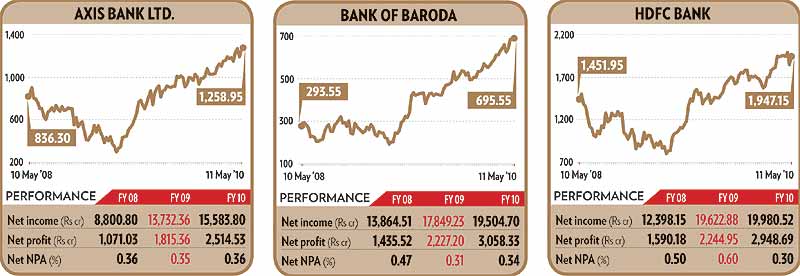
  • Axis Bank High business growth, low cost of funds, expanding NIM, improving asset quality
  • Bank of Baroda High growth in advances, best asset quality among PSU banks, high NPA provisioning, less volatile treasury income
  • HDFC Bank Consistently high growth, lower net NPA percentage compared to its peers, higher provisioning of NPA, large CASA base, high NIM
  • Punjab National Bank Low cost of funds, high yield on loans, maintains NIM in all conditions, higher NPA provisioning, less volatile bond portfolio
  • Yes Bank Lowest NPA percentage among listed banks, high growth, healthy NIM in spite of low CASA base

***

The Indian banking industry, unlike its peers in the West, came out relatively unhurt from the global financial crisis. The stocks, however, did correct a bit on the concerns of rising non-performing assets (NPAs) and loan restructuring. But, with the fear subsiding and the economy getting back to the higher growth path, there is renewed interest in the sector. The reasoning behind this is, if India has to grow at over 8-9 per cent, companies will need funds for expansion. In the absence of a vibrant bond market, they will have to tap banking sources for funding their needs. Therefore, investors are looking at this sector as a proxy to the India growth story. So, if you are also eyeing gains from the India growth story through the banking sector, we tell you how to look at stocks in the banking sector, and profile five banks we like at this stage.

Parameters

Core business. The core business of a bank is to lend, so it’s important to see how the advances have grown in the past, at least in the last few quarters. Looking at the growth in the interest income will also give you a fair idea. But, remember, this only a necessary but not a sufficient condition. Says Rajiv Mehta, research analyst at IndiaInfoline: “If a bank is growing at, say, 5-10 per cent faster than the industry, we try to analyse how it manages its margins and asset quality.” There is a possibility that to gain market share the bank might be ignoring the quality of lending.


Crests And Troughs

Although banking stocks fell along with the overall market as global crisis intensified, it has rebounded sharply and outpaced the overall market on prospects of economic recovery.


Asset quality. In banking, asset quality is of prime importance and looking only at profitability is not enough. “It [profits] is not the right criterion to look for a good bank; you should rather look at the balance sheet,” says Arun Khurana, manager, banking sector fund at UTI MF. He uses the example of Vijaya Bank. For FY10, it reported a profit of Rs 502 crore, or Rs 240 crore higher than the previous year’s profit of Rs 262 crore. Thus, its profit almost grew by 92 per cent. But, at the same time, its net NPA also grew by Rs 289 crore. Khurana suggests that one should reduce net profit by increase in net NPA to get the real profit figure because the bank is not sure whether it will recover NPAs. Also, from September 2010, banks will have to provide for 70 per cent of gross NPA, which will dent profits significantly for banks not making sufficient provisioning at this stage.

Net interest margin (NIM). It is a measure of the bank’s profitability, and is calculated as net interest income (interest income minus interest expenses) divided by interest yielding assets. This checks the bank’s ability to price loans at higher rates, which is also function of bank’s ability to mobilise low cost deposits—current account and saving account (CASA). The higher the CASA ratio, the better it is. Also, as we are moving into higher rate scenario, CASA will become even more important. Says Vaibhav Agrawal, vice-president, research, at Angel Broking: “As interest rates go up, the banks with the highest CASA account will perform the best.”

Other income. There are two big components of other income: fee income and treasury income. Although growth in fee income can be predicted somewhat, treasury income is relatively volatile. It depends on the wider interest rates situation in the economy, and is also affected by various factors like the monetary policy and government borrowing. As banks in India are required to keep 25 per cent of their demand and time liability in government securities, the overall effects of bond price movement can only be managed a little.

The road ahead

Unanimous projections. The fiscal year 2010 wasn’t too good for the banking industry in terms of loan disbursal. It remained subdued for most of this period, even as growth in credit fell to single digits at the end of October 2009. But later, as economic activity picked up, credit growth accelerated to around 17 per cent at the end of the financial year. Analysts expect it to remain robust. The offtake is once again expected to come from the infrastructure space, which, after a lull, has started witnessing higher activity. “Banks have raised capital in the previous year. Further, the government’s decision to infuse capital into some banks would increase their limit for infrastructure lending,” says Rajrishi Singhal, head of research and policy, Dhanlaxmi Bank.

Treasury Tricks. When the RBI followed the policy of lower interest rates to bring growth on track, the yield on government bonds came down. As a result, banks made huge profits on bond portfolios. However, that trend has reversed now. The yields have risen significantly, with impacts already visible on banks’ result for the March 2009 quarter. Most banks have suffered losses on bond portfolios. Analysts believe that in the coming quarters, too, the bond yield will remain high and it would be difficult for banks to show treasury gains. But yields are not expected to harden too much from here on. Economists expect yields on 10-year government paper to move at most to 8.5 per cent from the current 7.8 per cent. So, major negative surprises can be ruled out. Also if the government raises the FII limit in G-secs, as reported by the financial media, greater demand will raise their prices, thereby restricting the rise in yield.

Maintaining Margins. The net interest margin rose in FY10. One of the causes behind this rise was the high proportion of low-cost CASA deposits in the overall deposit base. As rates on term deposits were low, it became less attractive, and the share of CASA increased.

However, as term deposit rates have started to rise again, banks will face difficulty in maintaining the CASA level, even as pressure might be compounded by the lag that exists in adjustment of lending and deposits rates. Suresh Ganapathy and Mudit Painuly of Macquarie Equities Research, say in a recent report: “The previous interest rate cycle was testimony to the hypothesis that lending rates, particularly in the case of Indian banks, react with a two or three quarter lag, compared to deposit rates. We expect this lag, coupled with an increase in savings rates, to exert pressure on margins in FY11.”

Banking Picks

Axis Bank. It posted another quarter and year of impressive numbers. March 2010 was the 22nd quarter in a row when the bank posted net profit growth in excess of 30 per cent. During the year, net profit went up by 39 per cent, while the net interest income was up 36 per cent, showing growth of 47 per cent in 5-year CAGR. Similarly, the fee income for the bank grew by 51 per cent CAGR over the five years ending FY 10. The bank continues to maintain good asset quality with net NPA at 0.36 per cent compared to 0.75 at the end of FY06. During the fourth quarter, advances for the bank grew by a healthy 28 per cent over the previous year, against the industry’s growth of just about 18 per cent. The cost of funds also declined to 4.54 per cent against 6.64 per cent in Q4FY11, which led to improved net interest margins of 4.09 per cent.

On 12-month trailing earnings, the stock is trading at 18.78 times. Given that is consistently growing at over 30 per cent, the stock does not look too expensive.

Bank of Baroda. Bank of Baroda, or BoB, is a preferred pick in the public sector. A higher concentration in industrialised states such as Maharashtra and Gujarat gives greater push to its business. In FY10, deposits grew 25.3 per cent over the previous year. The yearly growth in advances was lower than the previous year, but, at 22.2 per cent, it was still higher than the average for the banking industry. The asset quality remained high, with net NPA at 0.34 per cent of the net advances, which is the best among PSU banks. The bank maintains a strong balance sheet by provisioning 74.90 per cent of NPAs. Another positive aspect of this bank is the low volatility of its treasury income, unlike other PSU banks, as it categorises most securities as held-to-maturity, which are not marked-to-market as bond yield fluctuates.

Factoring better earning visibility and superior asset quality, at Rs 695, BoB’s share is trading 8.24 times its FY10 EPS.

HDFC Bank. HDFC Bank’s stock enjoys the highest premium among the large-cap banks. The reasons are obvious. It has consistently maintained a high growth rate without compromising on asset quality. Advances have grown by 39 per cent annually in the past three years. In spite of high growth, its asset quality is still one of the best in the industry, at net NPA around 0.3 per cent of net advances. The provisioning coverage is also high. Even though its provisioning policy is conservative (making larger provisions), the growth in profit is high and in the previous 42 quarters, it has maintained around 30 per cent annual growth in net profits. Because of high CASA deposit (around 50 per cent of the total deposits), the net interest margin of the bank is high and has helped it report high growth in net profit.

At a price-to-book value of four and PE of 29, the valuation may not rise, but growth in earnings would support the price rise.

Punjab National Bank. It is the most preferred choice among public sector banks. The differentiating factor is its ability to maintain high net interest margins. High CASA deposits in the overall deposit base helps it lower the cost of funds, while high lending to MSME (micro, small and medium enterprises) enable it price loans at higher rates. As a result, the NIM remains high.

Though there is a relatively higher risk related to restructured loan portfolios, the already high provisioning will ensure that the impact is minimal when the restructured loans turn bad. Another positive factor is that the value of the bank’s bond portfolio is less volatile as around 80 per cent of it is categorised as held-to-maturity, which is not marked-to-market.

At a price of Rs 1,017.05, PNB’s stock is trading 12 times FY10 EPS—a level attractive enough to ride on the bank’s growth.

Yes Bank. With the best asset quality and a strong growth rate, it is among analysts’ favourite stocks in the segment. At the end of the March 2010 quarter, the bank had a net NPA of just 0.06 per cent, while operating profits were up by 67.3 per cent compare to the same quarter last year. For the whole of FY10, the operating profit was up 63.6 per cent, while net interest income witnessed an upswing of 54.7 per cent. Interestingly, despite significant improvement in the CASA, Yes Bank's low cost deposits were at 10.5 per cent, much lower than large banks. Despite this, the bank had a net interest margin of 3.2 per cent, which is significantly better than most public sector banks.

Yes Bank has built its expertise in corporate banking and retail constitutes a very small part of its business. However, going forward, in the second phase of expansion (2010-15), it plans to accelerate its presence in commercial banking and aims to grow its balance sheet from the Rs 36,382 crore at present to Rs 1,50,000 crore. In terms of valuation, on a trailing 12-month basis, the stock is trading at 17 times.

Investors entering this stock are advised to take a long term earnings expansion play and not PE expansion.

Long-Term Power Surge

We had recommended Power Finance Corporation (PFC)—a non-banking financial company focused solely on the funding needs of the power and related sectors—almost a year back, when it was at a level of Rs 200. Considering that PFC’s business has run in a stable manner in a difficult economic environment and it has future earnings visibility, at a price of Rs 276 today, the stock has gained 38 per cent in a year. We are re-recommending it as a long-term buy.

Business performance. PFC is a Navratna public sector unit that finances power generation, transmission and distribution projects. It is also the nodal agency, selected by the government of India, to facilitate development of power projects with capacity of over 4,000 megawatts, also called ultra mega power projects or UMPP. Although PFC’s consulting business contributes little to its total income, it does give a diverse mix to the company’s product portfolio.

PFC’s business has grown at a healthy pace over time. The compounded annual growth rate (CAGR) of loan assets in last five years is 22 per cent. In FY10, PFC’s loan book expanded by 24 per cent, which is higher than overall growth in bank credit. The commendable part is that despite high loan growth, the asset quality is impeccable. The net non-performing asset is just Rs 6 crore, or 0.01 per cent of loan assets.

PFC faces competition in the lending business from banks, but the nature of its capital gives it advantage over them. First, banks face asset-liability management challenge in financing long-term power projects, as it uses short-term deposits to give long-term loans. On the other hand, PFC has the advantage of raising funds by issuing long-term bonds to fund long-term assets. Second, there is a cap on lending by banks to any sector, whereas there is no such restriction for PFC, giving it a free hand to meet large funding demand from the power sector.

Financial performance. Its five-year (FY05-FY10) CAGR of total income is 19 per cent. In FY10, company’s total income grew by over 22 per cent, while profit grew by 19.5 per cent. The net interest margin has moved to 4 per cent. Several factors help PFC maintain its margin. It raises a major portion of its debt at a fixed cost and has the flexibility to price its loans. Therefore, it is not impacted much by interest rate fluctuations. PFC’s credit rating, equivalent to sovereign debt rating, also helps it raise fund at low costs. Unlike many other PSUs, the company maintains a lean cost structure, which boosts its margin.

Investment rationale. India, being a power-deficient nation, will need huge investment in this sector. The government too realises this, and work on several ultra mega power projects (UMPPs) has already started. Even if capital becomes easily available, not all the investment in the power sector will be funded through equity. This is evidenced in the current debt-equity ratio of around 3:1 for an average power project. So, clearly, the demand for debt will exist and PFC is well positioned to take advantage of this opportunity. It also has an edge over banks.

Besides financing power projects directly, it has also started financing power companies’ purchase of raw materials. Another initiative is to finance power sector equipment manufacturers. Combined, these give visibility to PFC’s future earnings. Its track record in maintaining quality assets is another plus.

Considering these, PFC’s stock at Rs 276, or 13.45 times FY10 earnings per share, is attractively priced and will be a long-term bet for you in the sector.

AT&T buys 8.07% stake in Tech Mahindra

AT&T has bought 8.07% stake in Tech Mahindra for $200 million. AT&T bought the stake from British Telecom. This stake sale will bring the stake of British Telecom to 22.79% from 30.85%. With 40% of Tech Mahindra’s revenues coming from BT it is Tech Mahindra's biggest customer also.

British Telecom has been reducing its stake in Tech Mahindra strategically. And Tech Mahindra has strategically reduced its exposure to BT. Buying the scam ridden Satyam computers and renaming it to Mahindra Satyam is a part of this plan.

Shareholder pattern before the deal :

Shareholder pattern after the deal :

Top 18 power companies by market capitalization

Power is the flavor of the month. If I have to say it has been the flavor of the past 2 years. But, I want to leave Reliance Power IPO nightmares behind. Now, power seems to be gaining traction one more time.

Adani Power which did not get a favorable response from the secondary market has revived the primary market. Few other power companies are lining up for IPO’s. NHPC is another power company which recently closed the issue.

All the power companies the list show a trend. It is either owned by government or it comes from the biggest conglomerates and business houses. Many of the power-generating PSU’s are not publicly listed. After all private sector contributes to only 14% of the total installed power. Public sector (state and central combined) contributes 86% of the installed power capacity.

Top 18 power companies in India by market capitalization :

Name Market cap in crores
NTPC 173279.18
Reliance Power 39307.52
Tata Power 29625.01
Reliance Infrastructure 25969.24
Adani Power 22912.12
Neyveli Lignite 21885.73
Reliance N.R 14567.43
Torrent Power 11031.71
GVK Power 7706.5
KSK Energy Ventures 7209.26
CESC (Calcutta Electric Supply Corporation) 4484.72
Jaiprak Hydro 4112.13
BF Utilities (division of Kalyani Group) 3507.84
Guj.Ind.Pow. 1529.14
Indowind Energy 220.32
Energy Dev. 176.96
Suryach.Powr 143.68

NTPC also happens to be in the list of top 10 companies in India by market cap. Rest of the list is dominated by the Ambani’s Adani’s and the Tata’s.

Don’t confuse the top power companies by market capitalization with the top power companies which produce maximum power. Reliance Power when it was listed did not have 1 MW in production. Same is the case with Adani Power.

PSU's Short-term pain, long-term gain

Govt’s move to hike public shareholding in listed companies could lead to lower share prices in the interim.

The recent move by the government to have companies maintain their public shareholding at a minimum 25 per cent, while being good in a few ways, could see an oversupply of stocks in the market place. It could even lower share prices for companies.

In fact, with companies expected to fulfil the norm by divesting at least five per cent every year, the markets may see a supply of paper worth Rs 1,50,000 crore in the next few years. Of this, analysts expect issuances worth around Rs 59,000 crore in the next 12 months. This could create a situation of oversupply and investors, therefore, need to reassess their portfolio and arm themselves with a strategy to combat this, say experts.

Of the estimated supply of new equity into the market, public sector undertakings (PSUs) will dominate the show, followed by the Indian private sector and then the multinationals. Here, experts recommend a cautious approach, while taking an investment call.

LOW ON PUBLIC OWNERSHIP
Company Promoter
stake (%)
FPO amt
(Rs cr) *
PUBLIC SECTOR
MMTC 99.30 38,424
NMDC 90.00 17,603
NTPC 84.50 15,952
Hind Copper 99.60 11,335
SAIL 85.80 9,904
PRIVATE SECTOR
Wipro 79.50 4,569
Rel Power 84.80 3,834
JP Power Ven 87.70 1,966
DLF 78.60 1,911
Mundra Port 80.20 1,540
MULTINATIONALS
Oracle Fin 80.50 993
Gillette India 88.70 703
Alfa Laval 88.80 351
Fres Kabi 90.00 319
BOC India 89.50 270
*Estimated, based on current market cap; Top companies by market cap wherein public float <25%, according to category
Source: JPMorgan

Broader market pressure
Overall, there is expected to be weakness in the market place as the supply of paper could hamper sentiments. According to a JPMorgan research report: “The change in regulation, coupled with the capital-intensive phase that the Indian economy is in, implies that, over the medium-term, equity issuances as a percentage of outstanding market capitalisation could be three-five per cent.” This is more than the long-term average of issuances, forming two per cent of the market capitalisation.

The five per cent issuances-to-market capitalisation ratio is not seen as a major issue. But the problem is that it comes at a time when risk-aversion is high among overseas players.

The month of May has already seen an outflow of Rs 9,400 crore, and there is pressure on the domestic institutions to support the markets. JPMorgan analysts believe global risk appetite will, however, have to be supportive for absorption of the fresh equity issuances, given India's dependence on external capital.

While there is an expected pressure in the short-term, the move will improve market strength over the long-term. According to Vallabh Bhanshali, chairman of Enam Group: “This will help PSU divestment, as it will be fast-tracked. Higher proceeds from divestments will improve government finances and, in turn, help the reducing fiscal deficit. In the short-term, what may happen is that the primary market will crowd out the secondary market. However, investors should not worry about the impact as, generally, both the markets move in tandem.”

Motilal Oswal, chairman of Motilal Oswal Securities, says: “There is sufficient liquidity and many overseas investors have evinced an interest in picking up shares of Indian PSUs. So, over the long-term, this should be seen as a positive move for investors.”

There could then be a flurry of issuances from various sources. The most likely would be qualified institutional placement (QIP) and follow-on public offers (FPOs). However, the latter option will be rather difficult.

“We have seen most of the FPOs bomb and only some have scraped through. This route will not be successful,” says Prithvi Haldea, chairman of Prime Database, a company that tracks capital market issuances by the corporate sector. Therefore, the extent of dilution would be lesser than expected.

Stock impact
The impact of this notification is expected to be diverse on various stocks. While existing investors are likely to feel the pinch in the form of a decline in share prices, they could use this opportunity to increase their presence in such quality stocks as Wipro, Mahindra Holiday, Sun TV Network and Godrej Properties. And, it would also be pertinent to look at the extent of supply hitting the market.

Analysts expect multinationals to go private and delist from the stock exchanges, rather than dilute their holdings in Indian arms. For this to happen, they may come out with attractive buy-back offers. Should this (delisting) occur, investors will get a good chance to move out at attractive returns.

The problem would exist for the bigger companies who will have to reduce their holdings by a substantial amount. In the present weak global scenario, this would be a daunting task, and push their share prices visibly lower. However, investors are advised to gauge the fundamentals of these companies, before taking a call.

And, as Bhanshali says: “One should not be worried about the short-term impact on valuations, and should see this from a long-term perspective.”